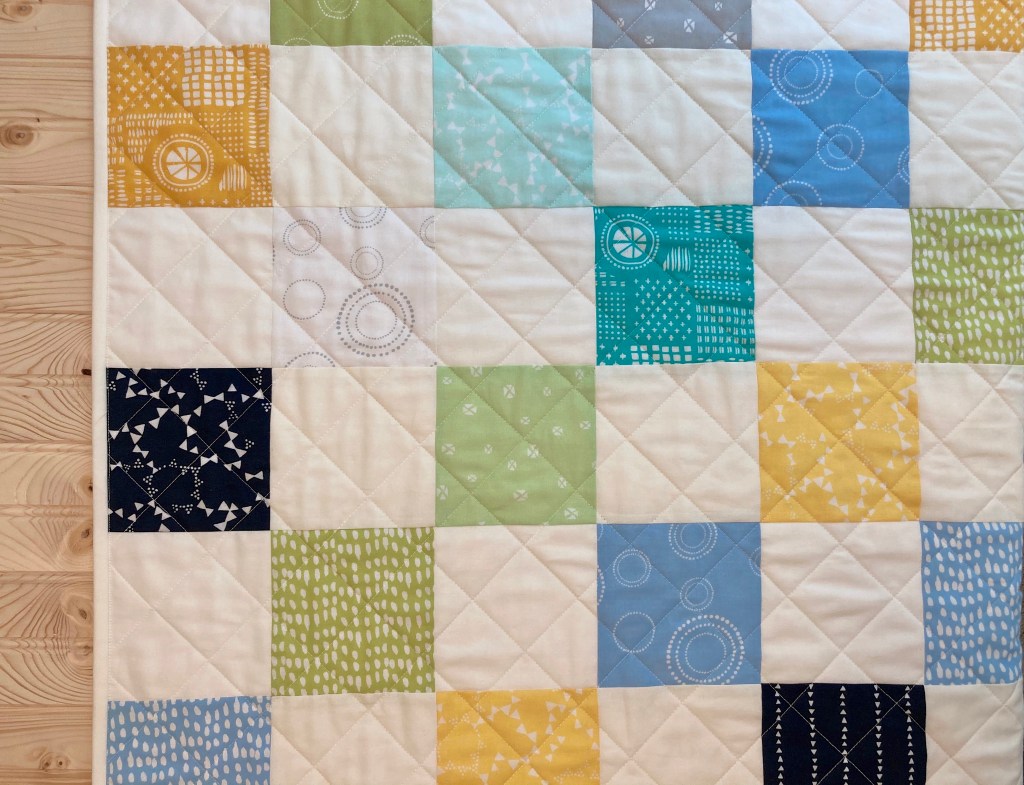
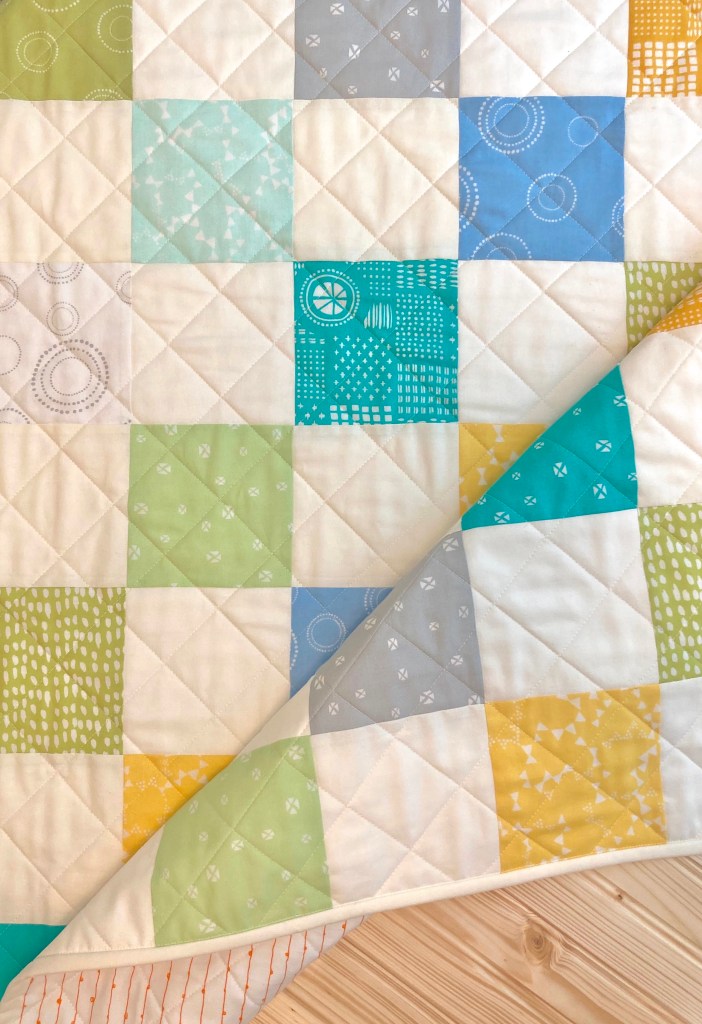
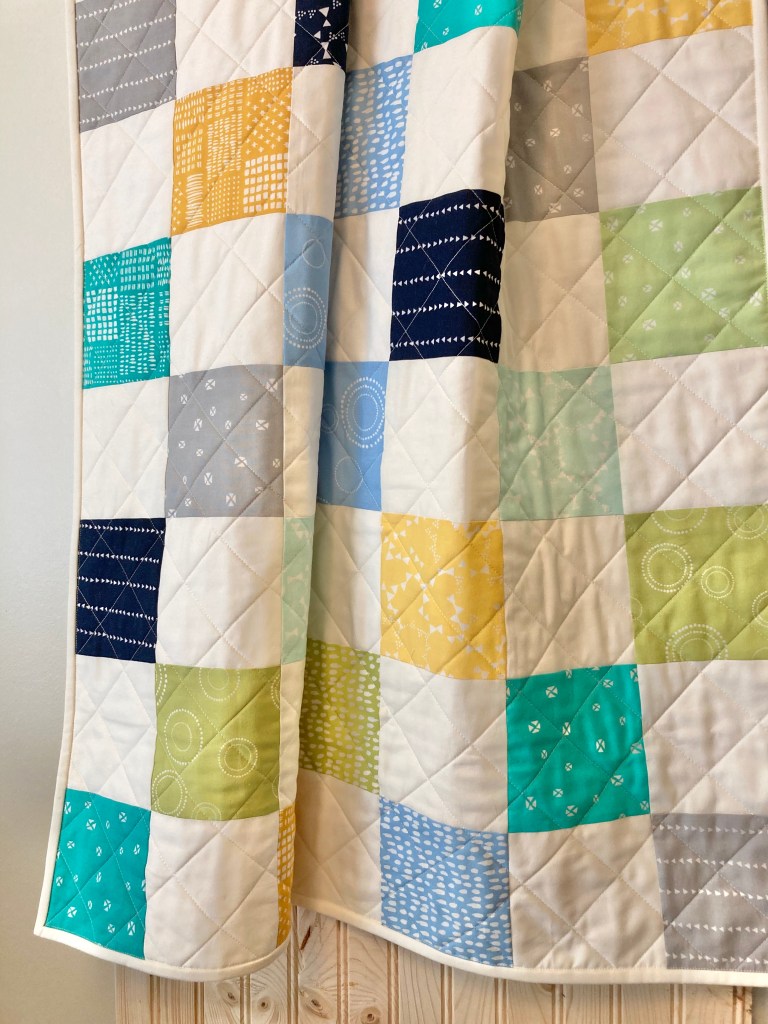
If you’re thinking about taking up quilting as a new hobby but aren’t sure where to begin, I’ve got an easy, basic pattern that’s excellent for the complete beginner, the Checkered Baby Quilt. This quilt is a perfect starter for several reasons—it’s sewing simple squares together, there are no bias edges (when edges can stretch easily), seams nest (fit into one another stress-free) and it can be made with 5″ precuts. For the quilt top you need only two charm packs. And best of all, there’s no pattern to buy, just download my Checkered Baby Quilt tutorial. Easy, right?
I’ve made a few Checkered Baby Quilts and have given them as gifts and I’ve even made a couple for commission, so it’s definitely a classic that stays in style.
Checkered Baby Quilt made with stackers from Riley Blake’s Little Prince collectionCheckered Baby Quilt made with Moda’s Pepper and Flax and various other prints
The last one I made with Lily and Loom fabric from Craftsy (remember Craftsy?) and Kona Cotton Solid Snow. I chose crosshatch quilting at 2″ apart and a solid binding.
Other reasons why this is great for a new quilter is that it’s a nice sized project suitable for experimenting with color, fabric, thread, quilting designs, etc. All of those quilting elements are part of the learning process plus it’s a lot of fun. So if it’s time to get started, why not grab a couple of charm packs and try this one out?!?
In keeping with my goal to use fabric on hand, a few weeks ago I decided to pull all my leftover 5″ squares and make a quilt out of them. Due to the large variety of prints it was a risky move, leaving me to question if all the fabrics would blend. Nonetheless, I was determined to make it work.
I planned to make another Four Patch Charm quilt (I’d made one back in September) that required 96 five inch squares. From the pile, I had about half. Needing another 45 or so, I headed back to my stash of leftover fabric and pulled what I thought would work. That batch included fabrics from my first quilt, other quilts, various small projects, quilt backs, bindings, etc. I cut until I reached my number.
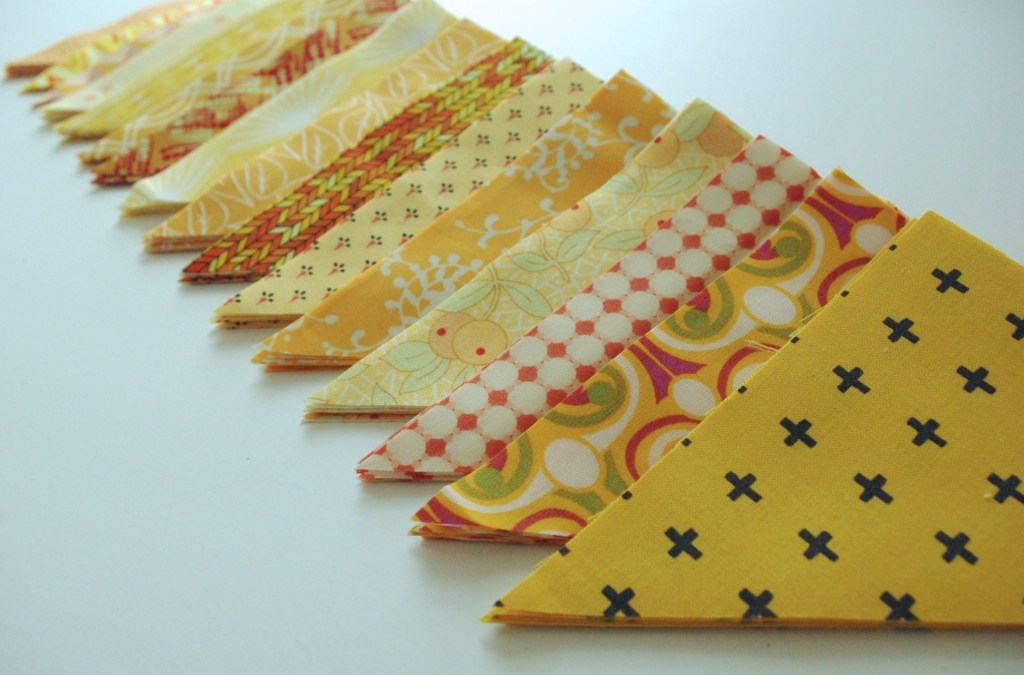
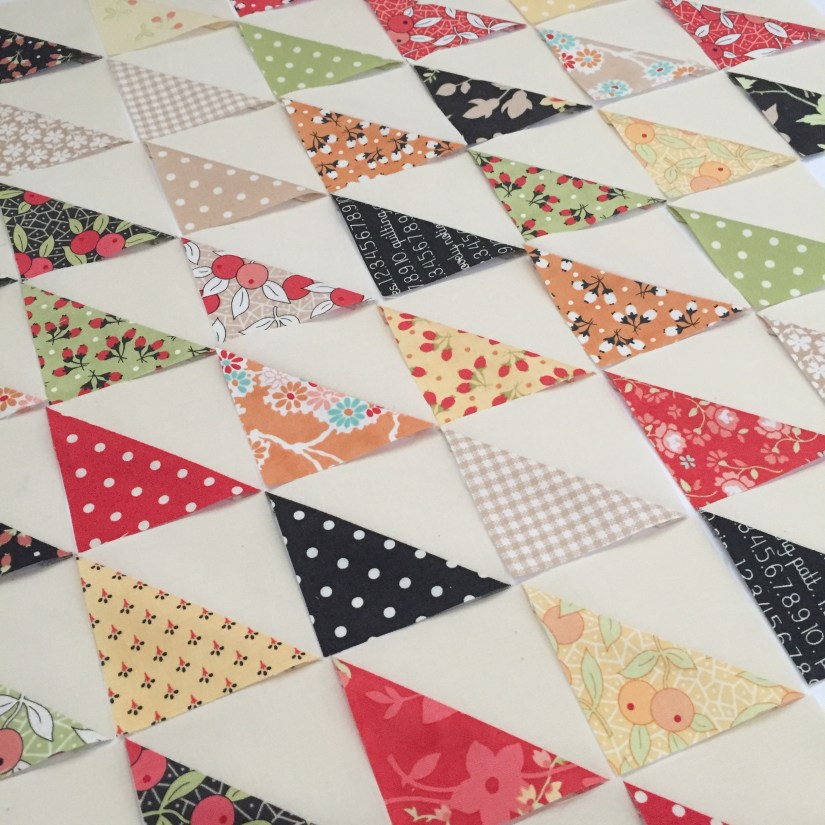
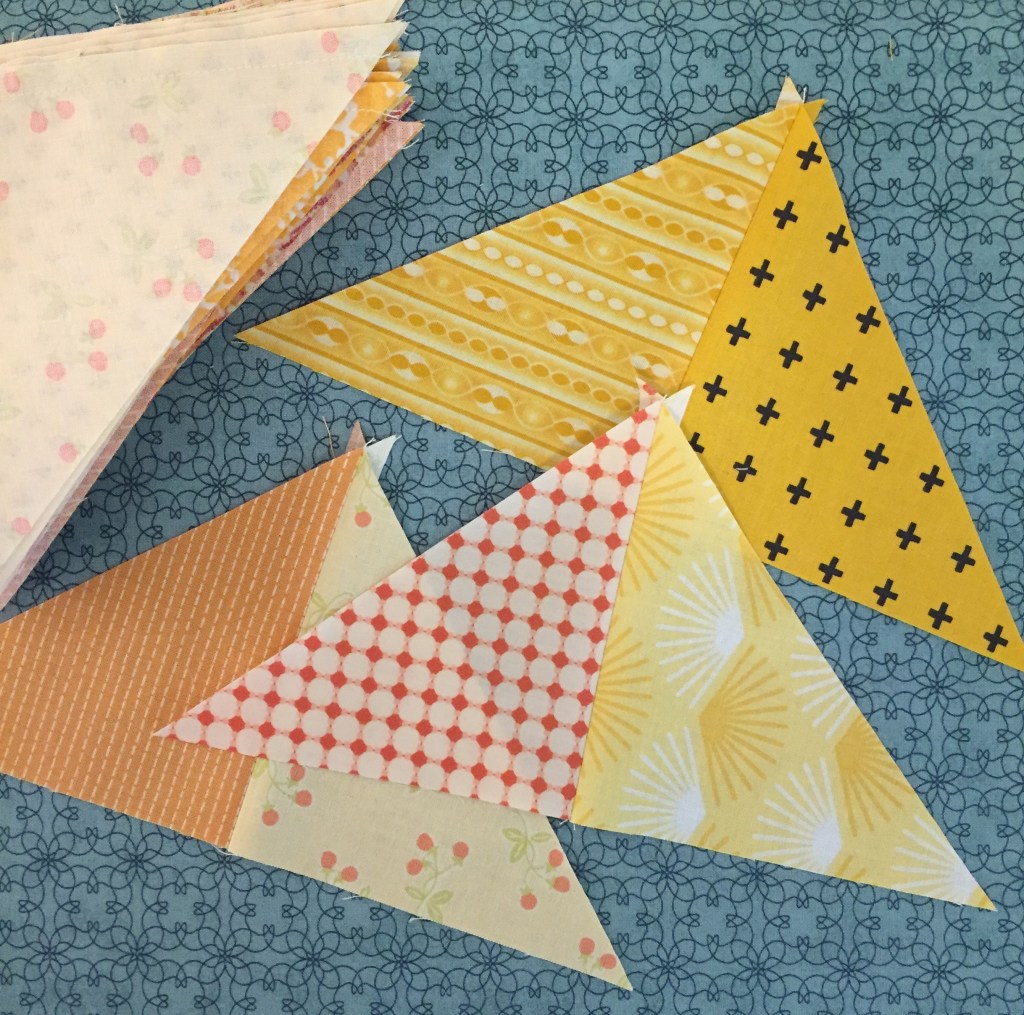
To get started, the pattern required the squares to be cut in half diagonally then sewn in pairs.
After sewing together of 96 pairs, I still wasn’t sure if everything would look OK even though I blended colors as best as possible. Then I thought, well, everyone loves scrappy, right? How could I go wrong?
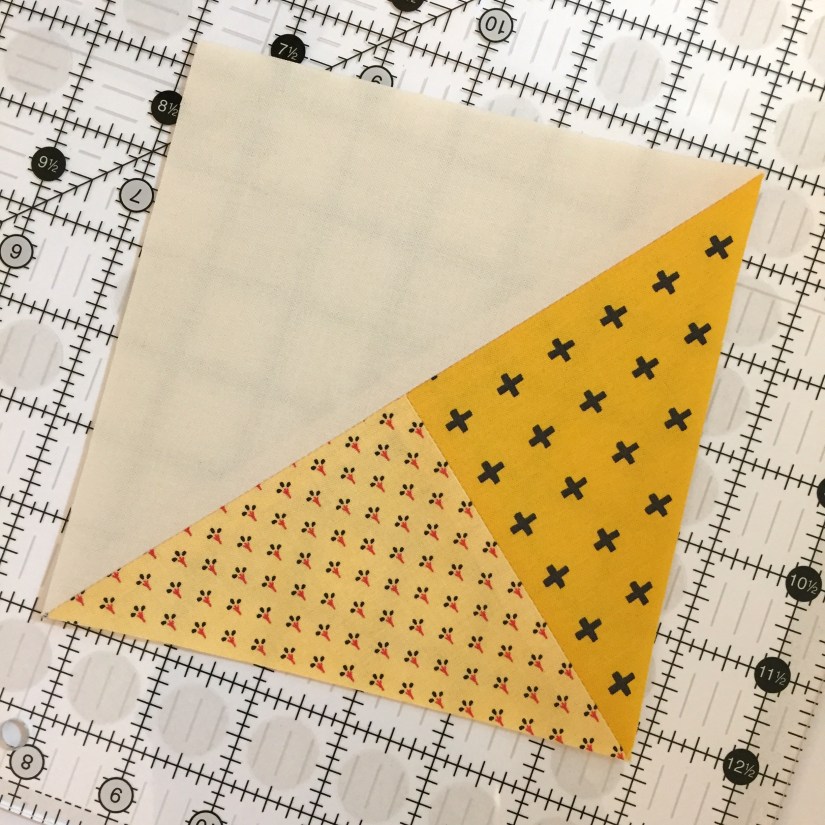
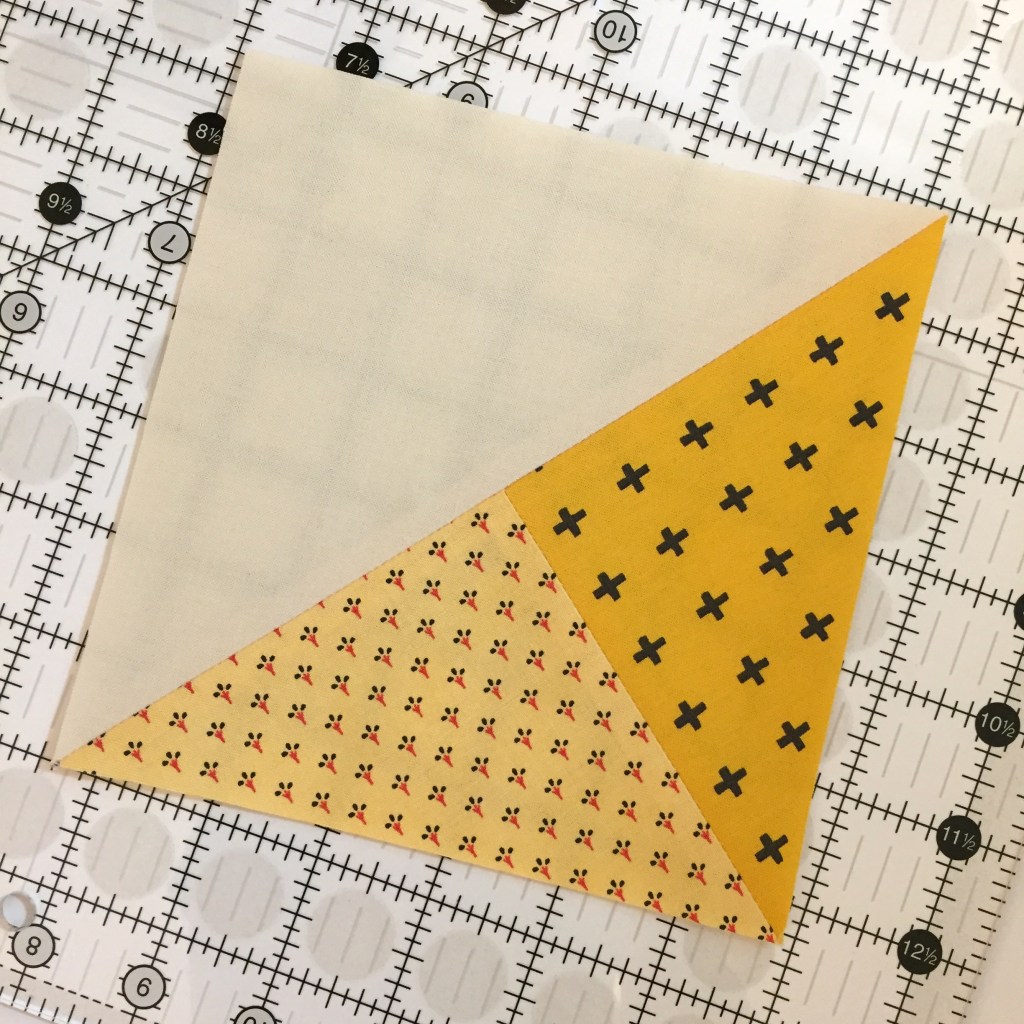
To finish the blocks, I used Kona Cotton Snow (the background triangle) choosing it for a less-than-bright-white look. The next step, trimming blocks. You can see they were pretty close to the size needed, but I never skip this step. Sure, it’s time consuming but it’s always, always worth the effort. 🙂
The layout didn’t take much time, as it was one of those quilts where you move one block it messes up the colors in another area, so I left it pretty much as I laid it out initially. Once I’d gotten to this point I was happy with how the colors worked together and I liked it more than I thought I would.
I quilted a 2″ square grid to compliment the diagonal pattern, and made scrappy binding using four different fabrics found in the quilt top.
For the back, I used a pleasant blue and white hexagon fabric from Moda’s Victoria line.
At last, here’s the finished quilt! I have no plans to keep this one for myself, I hope to give it as a gift to someone, sometime.
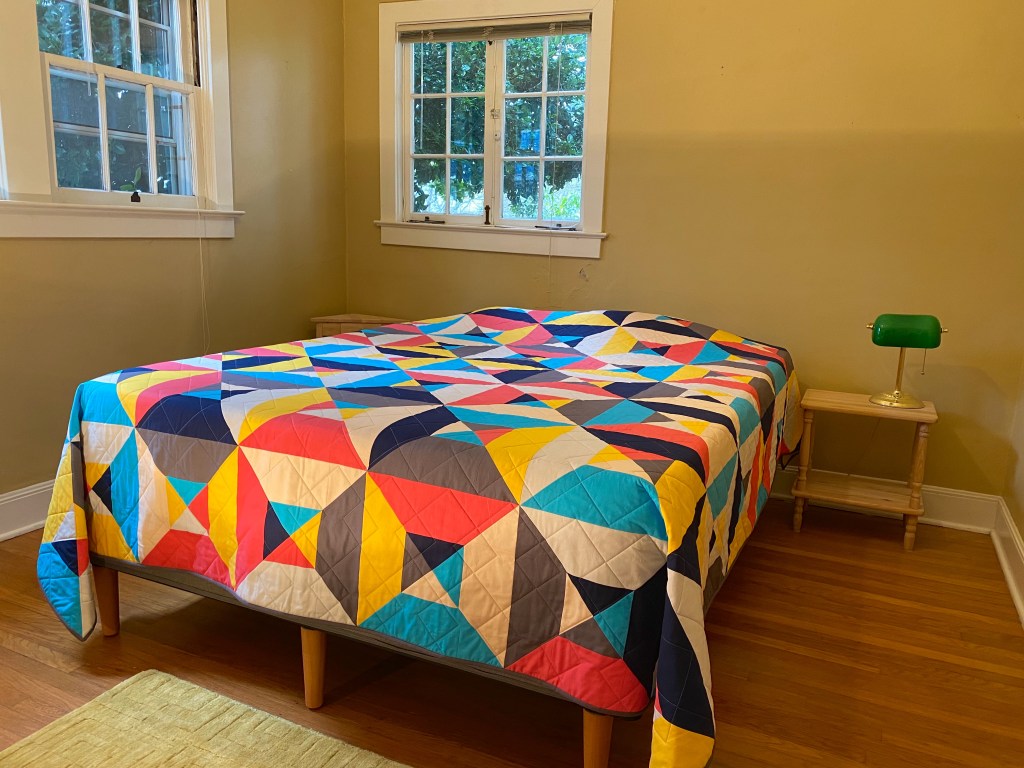
It finally happened, I finished another queen size quilt. In 2018 I made one for my daughter so 2019 was the year to make one for my son.
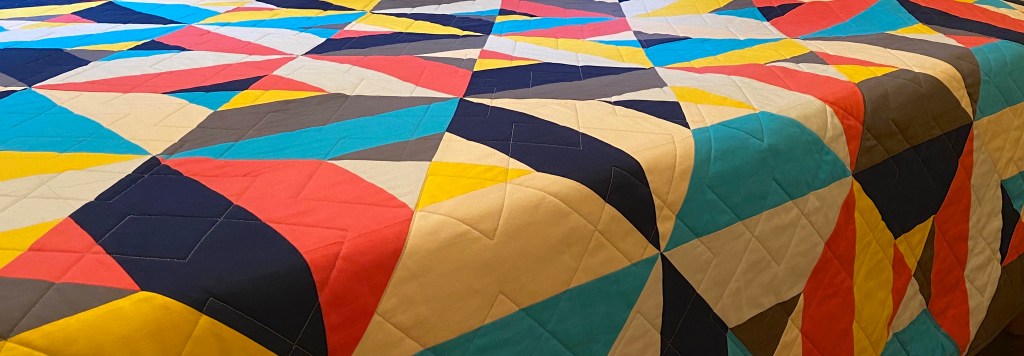
Since this is more than likely a one-time thing, I wanted to make it for him as per his request. To start off, I had him choose a pattern. Probably not so much fun for a young man to sit and go through quilt pattern after quilt pattern, but ultimately it was his choice. 🙂 After much searching, he decided on a pattern by Michelle Bartholomew called Picnic Play.
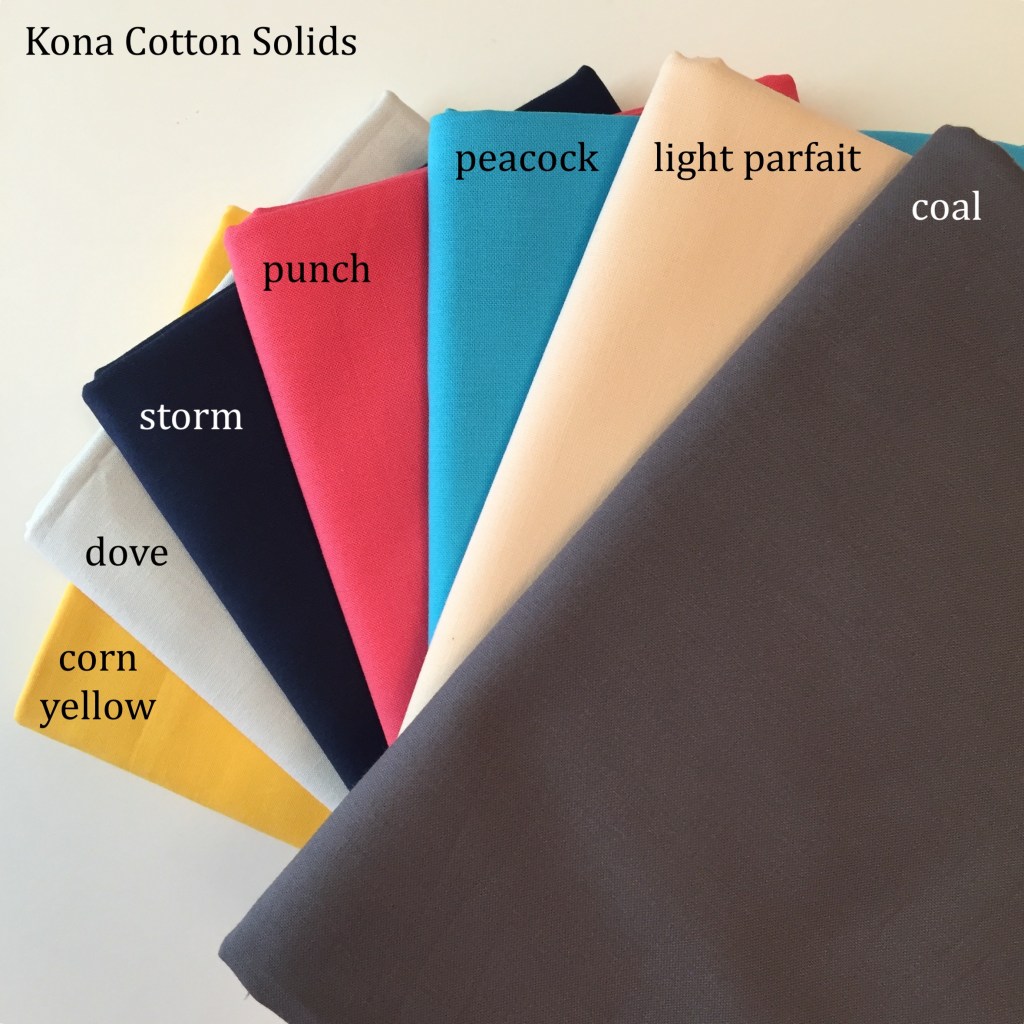
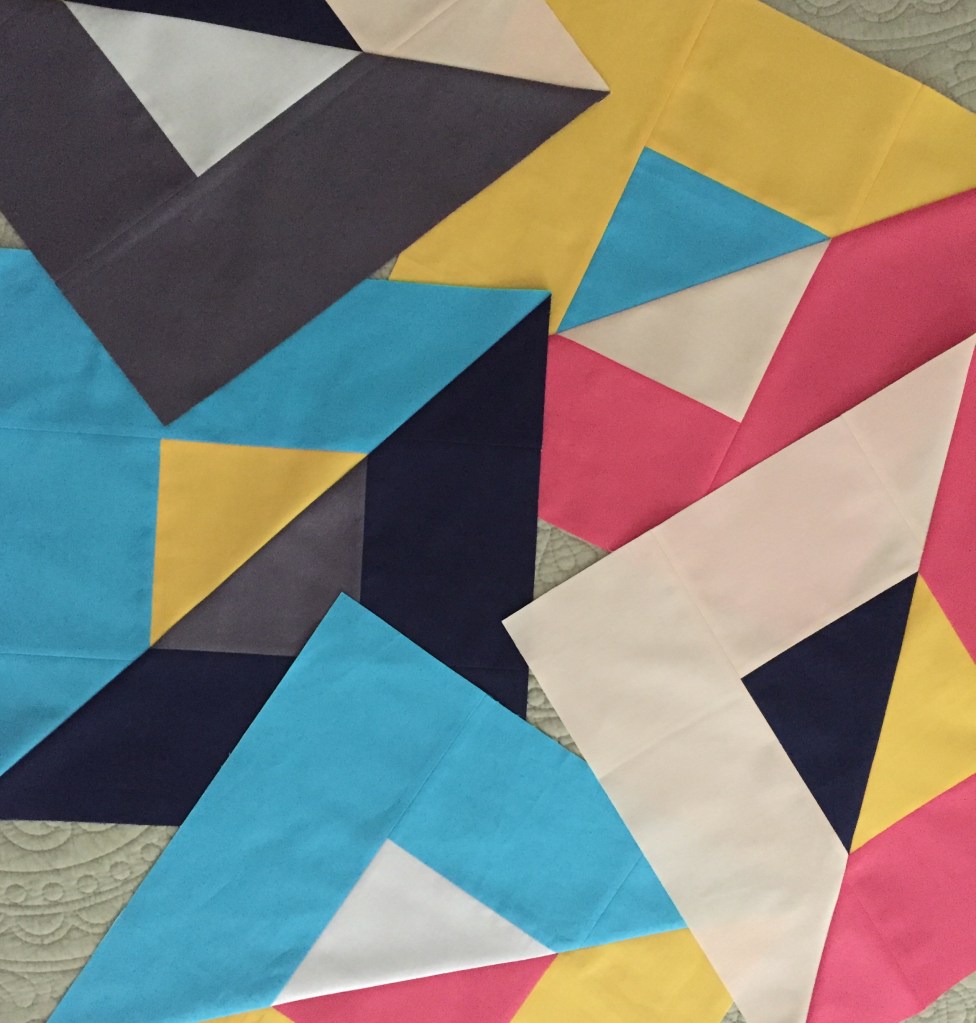
It’s a very modern quilt and perfect for a guy, which isn’t always easy to find in the quilting world. The pattern requires seven solid fabrics; and while the original pattern colors were a good starting point, he swapped out a few and here’s what he chose:
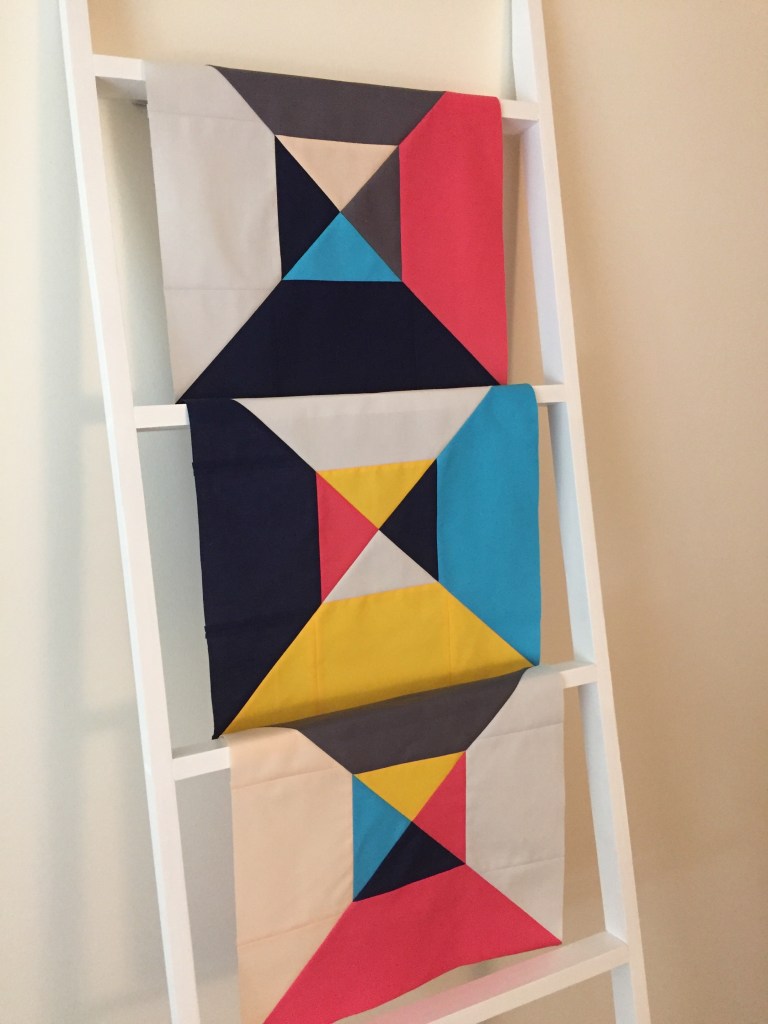
As far as the block construction goes, they’re kind of like an extended hourglass block, and they were a lot harder than I thought they’d be! They were relatively big too, unfinished at 14″ square.
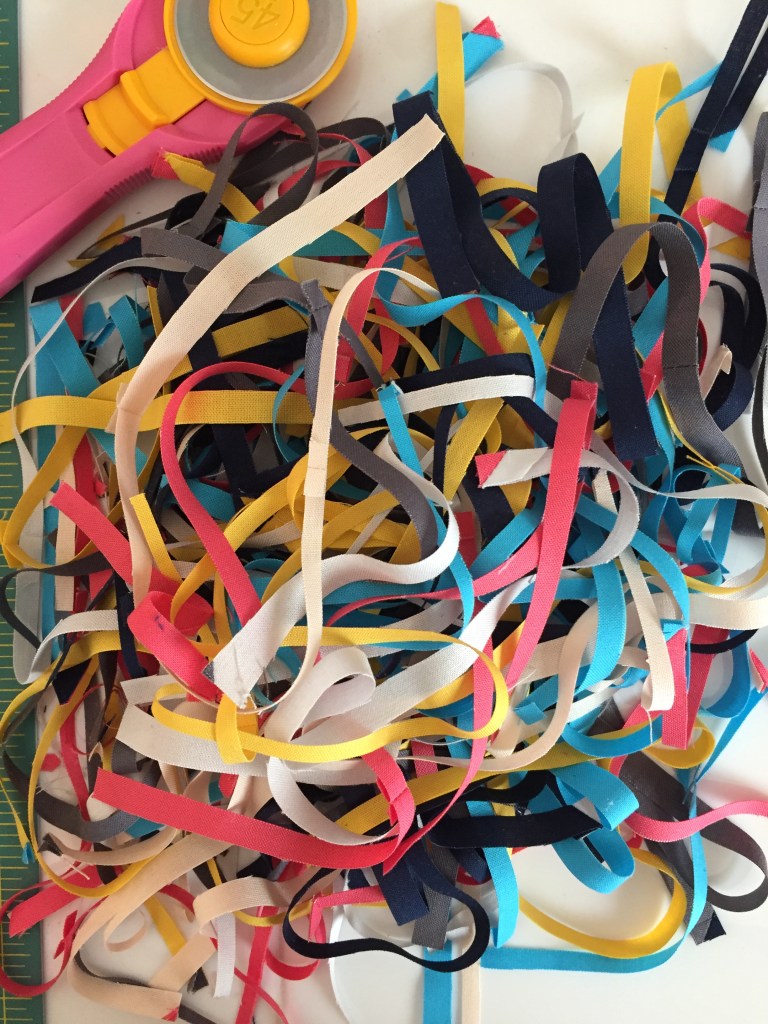
And since the pattern was written for a throw, we had to do some math to figure out how many additional blocks I’d need to add to get it queen size. Trimming for 56 large blocks took quite a while, but what colorful trimmings.
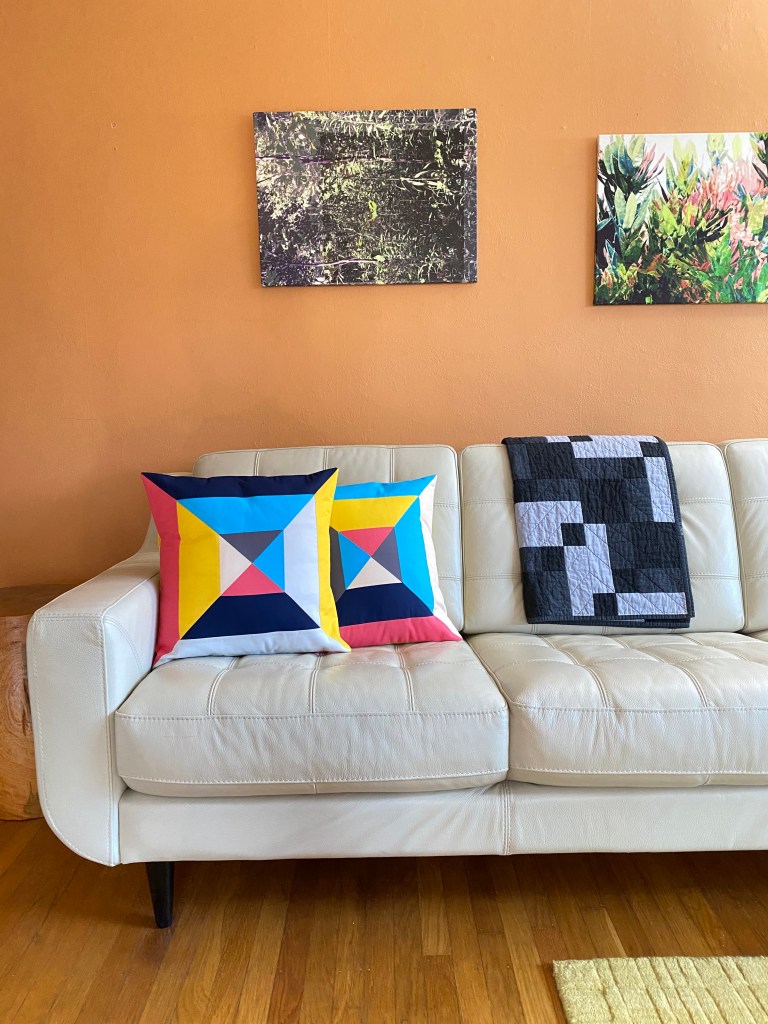
Yet somehow and somewhere along the way I miscounted the number of blocks and ended up with a few extra. No problem—I made toss pillows.
I should mention that making these pillows wasn’t so easy, I had to extend the blocks even further to get them to 18″ square. My process for doing this is explained on my Mitered Borders on Pillows blog post.
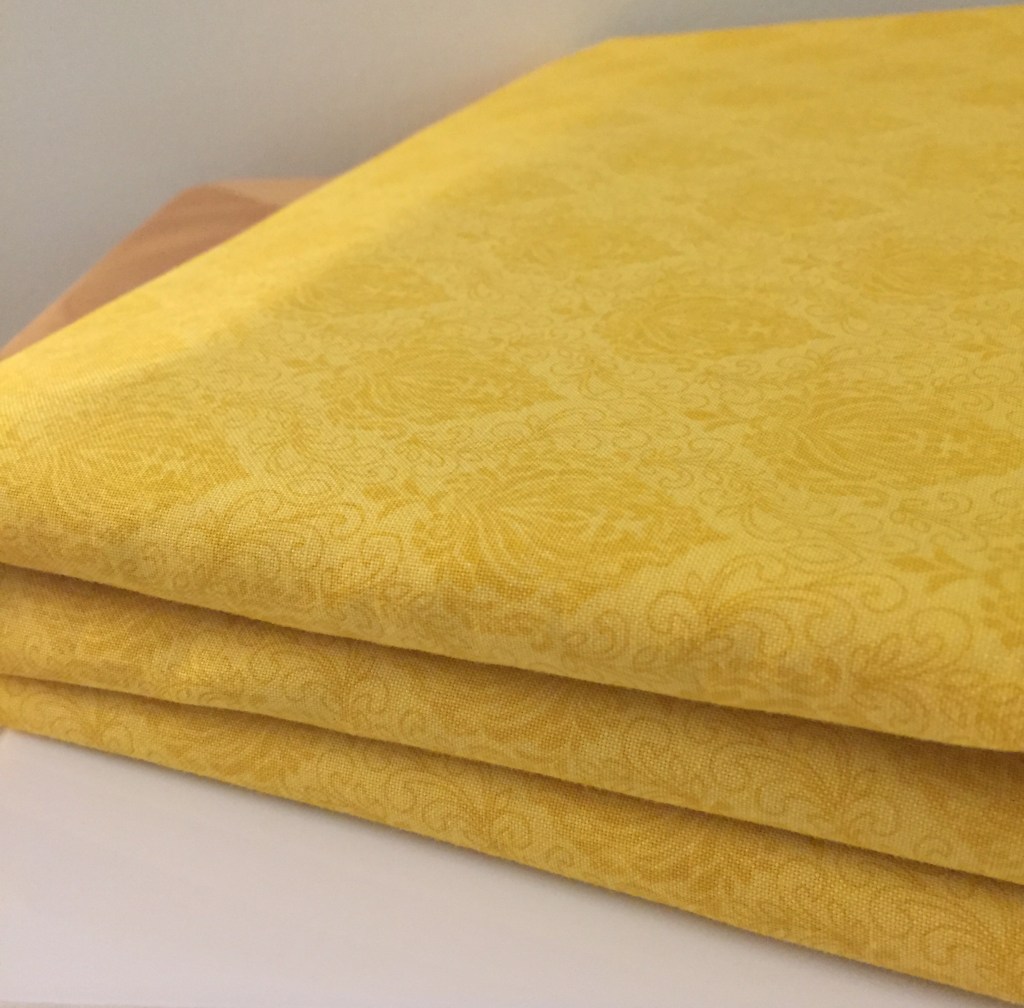
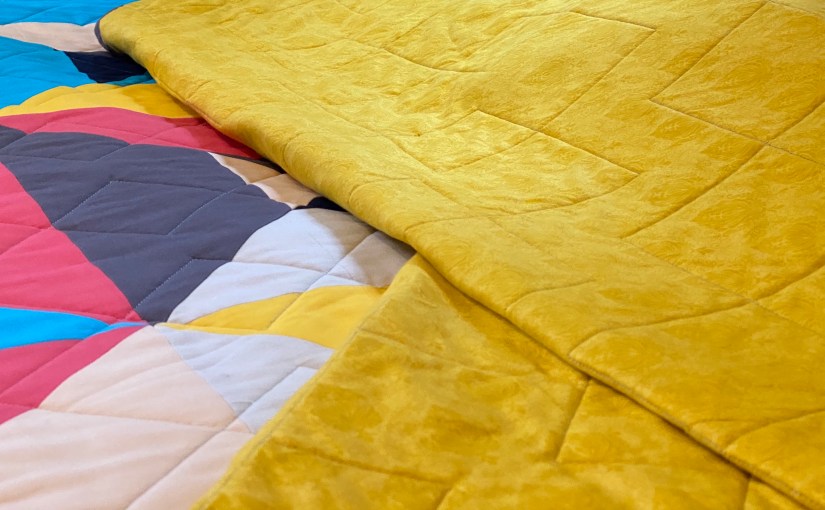
When it came time for purchasing backing fabric, I didn’t think my son would have much interest so he told me what color he wanted and I sent him a few choices. He decided on a warm, tone on tone vertical print by Windham Fabrics, Eliana Medallion in Sunshine.
The same process happened for the quilting. I sent him three patterns and he ended up going with Knitterly #2 by Urban Elementz. I think it was a great choice!
I really enjoyed working with bright solids and it was a lot of fun to make something this modern.
So…after many months in the making, a lot of decisions, waiting forever for longarming, sending it across the country and hoping it arrived safely, and in time for Christmas, here it is!
The quilt finished at 95″ x 108″. My son is really happy with it and is enjoying its warmth. And that’s exactly why we quilt…isn’t it?
Giving away quilts is half the fun, isn’t it? I’ve purposely made most of the quilts I’ve given as gifts, but I got to thinking recently…what if I need one for a gift and I don’t have time to make it? This, of course, set my mind reeling so naturally I had to make a quilt ‘just in case’ because you never know!
My first thought was it has to be a quilt that would work for any occasion and anybody (I might have messed up the ‘anybody’ part after putting a floral backing on 🙂 ). Anyway…a pleasing pattern in a nice throw size would do. I always wanted to make an Around the World type quilt so I decided on the Four Patch Charm pattern by Kathy Schwartz that finishes 63″ x 69″.
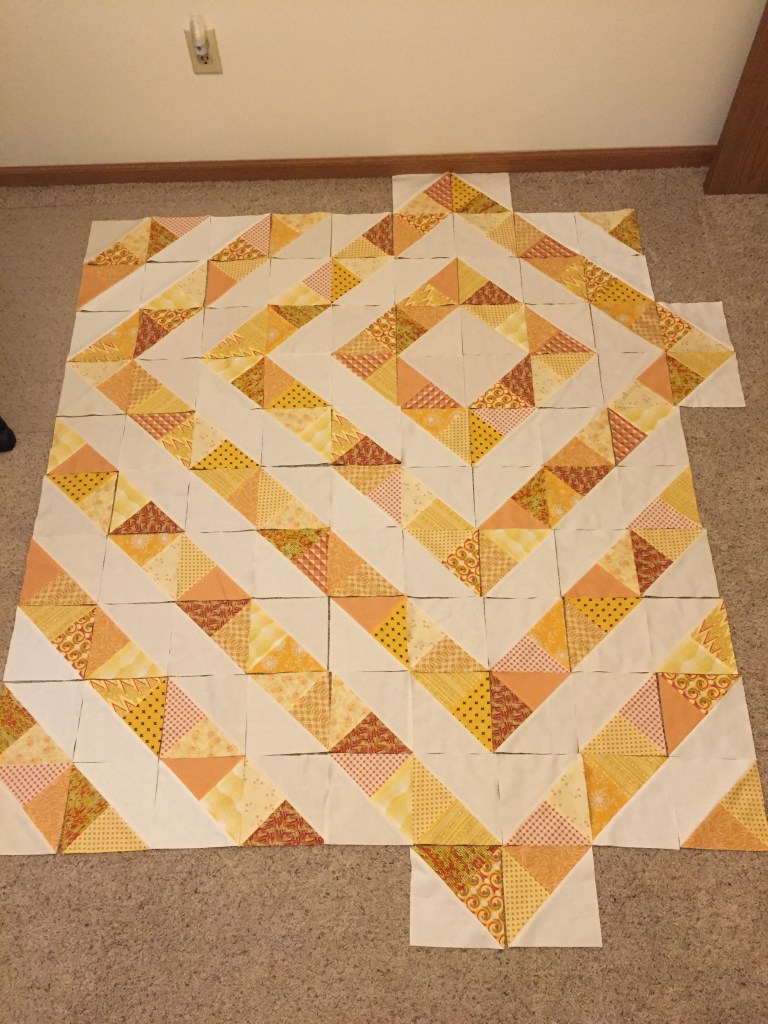
I’m still sewing with fabric I have on hand, and luckily I had enough golds and yellows in my stash for this project. I used 16 different prints to avoid too often of a repeat. I also had approximate one yard sections of solids for the background so I blended three different colors, Kona Bone, Kona Snow and Bella Wheat. I placed them in symmetrically so mixing the colors worked.
I liked that this pattern introduced me to a new block, and it helped me to overcome my fear of bias edges.
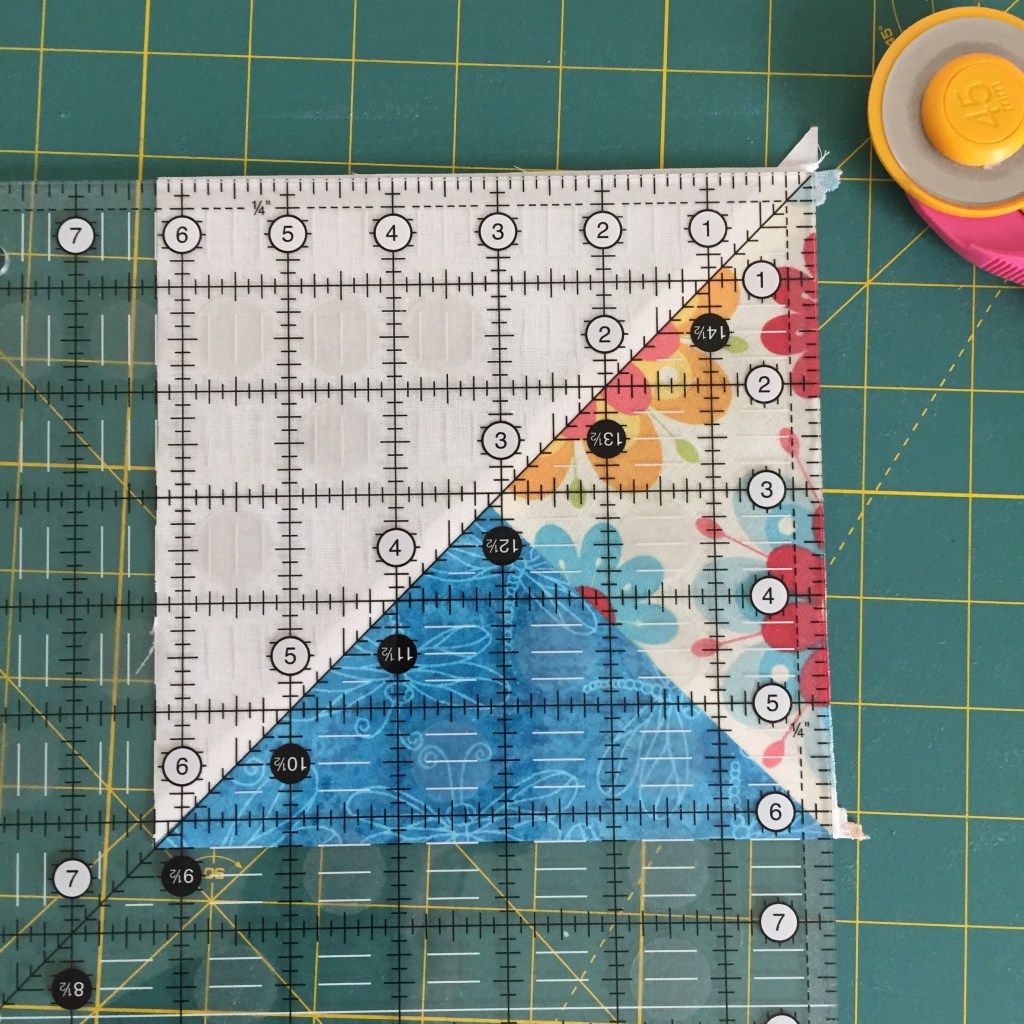
half quarter square triangle
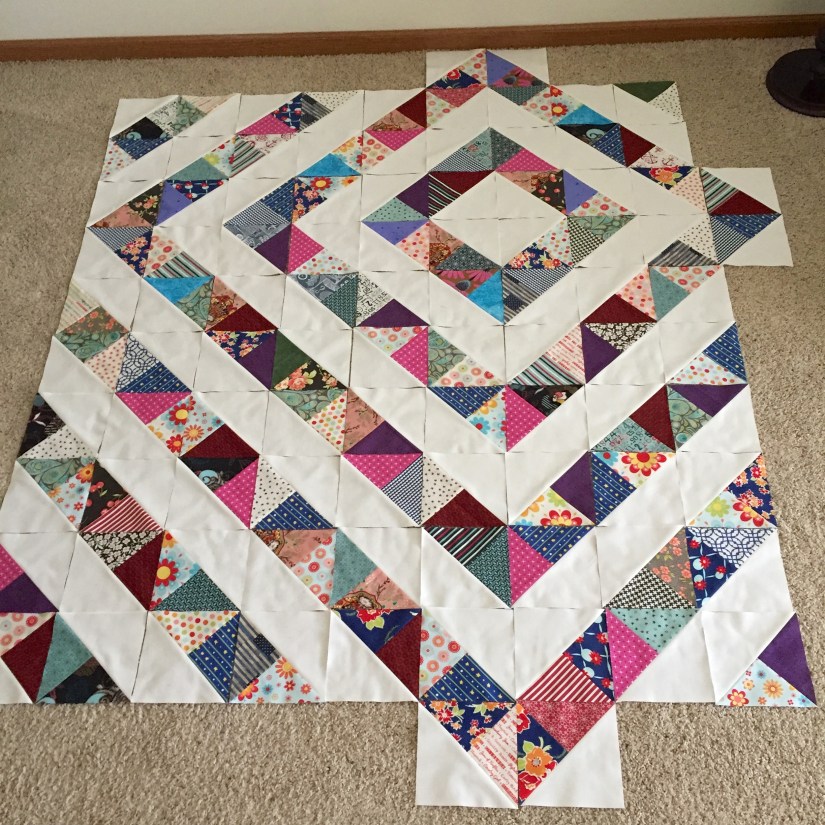
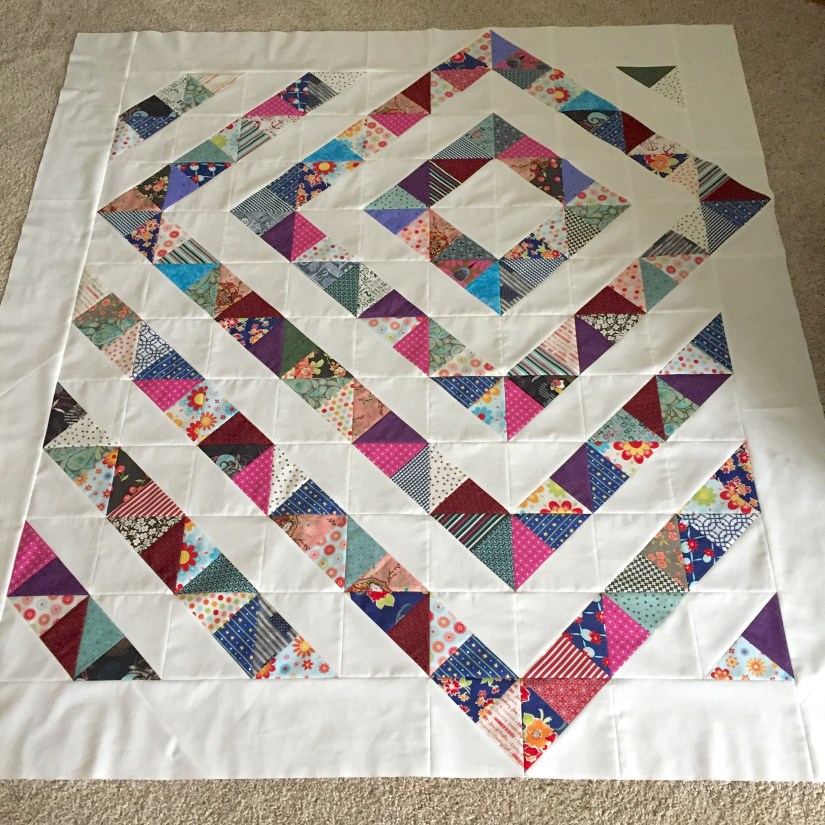
Everything went together relatively fast, and the layout was a lot of fun even though I had to do so on the floor.
Also in keeping with using only what I had, I made scrappy binding.
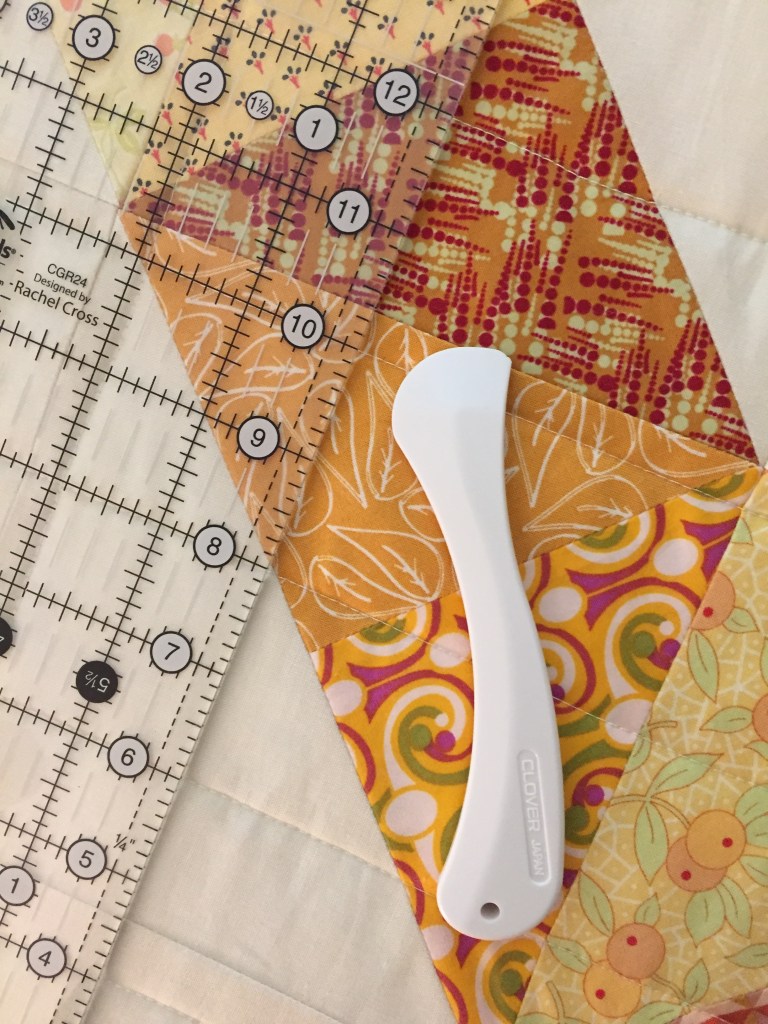
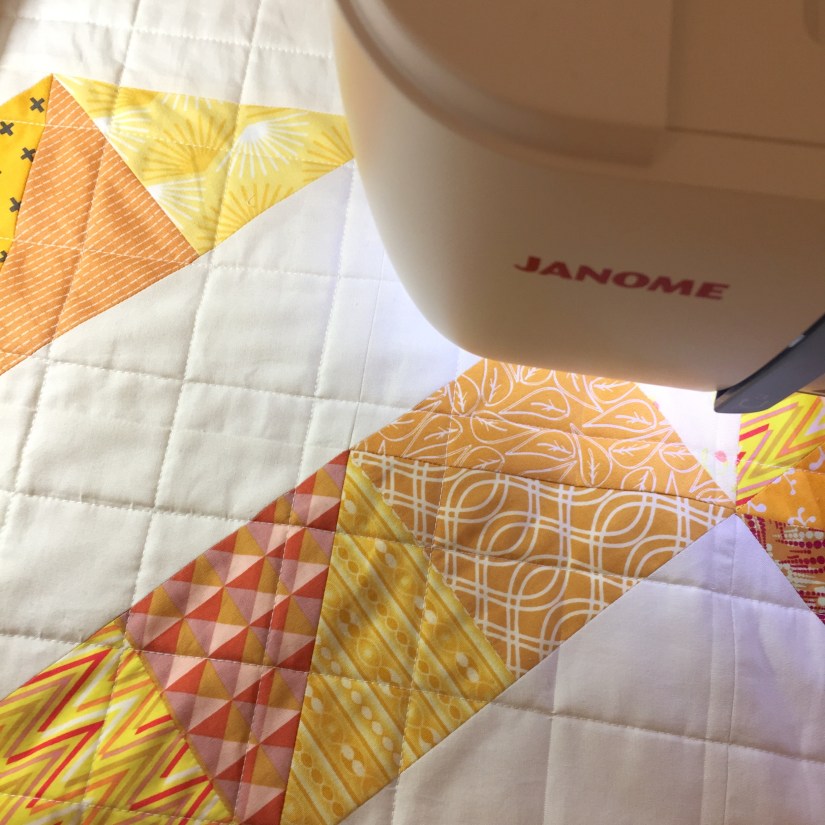
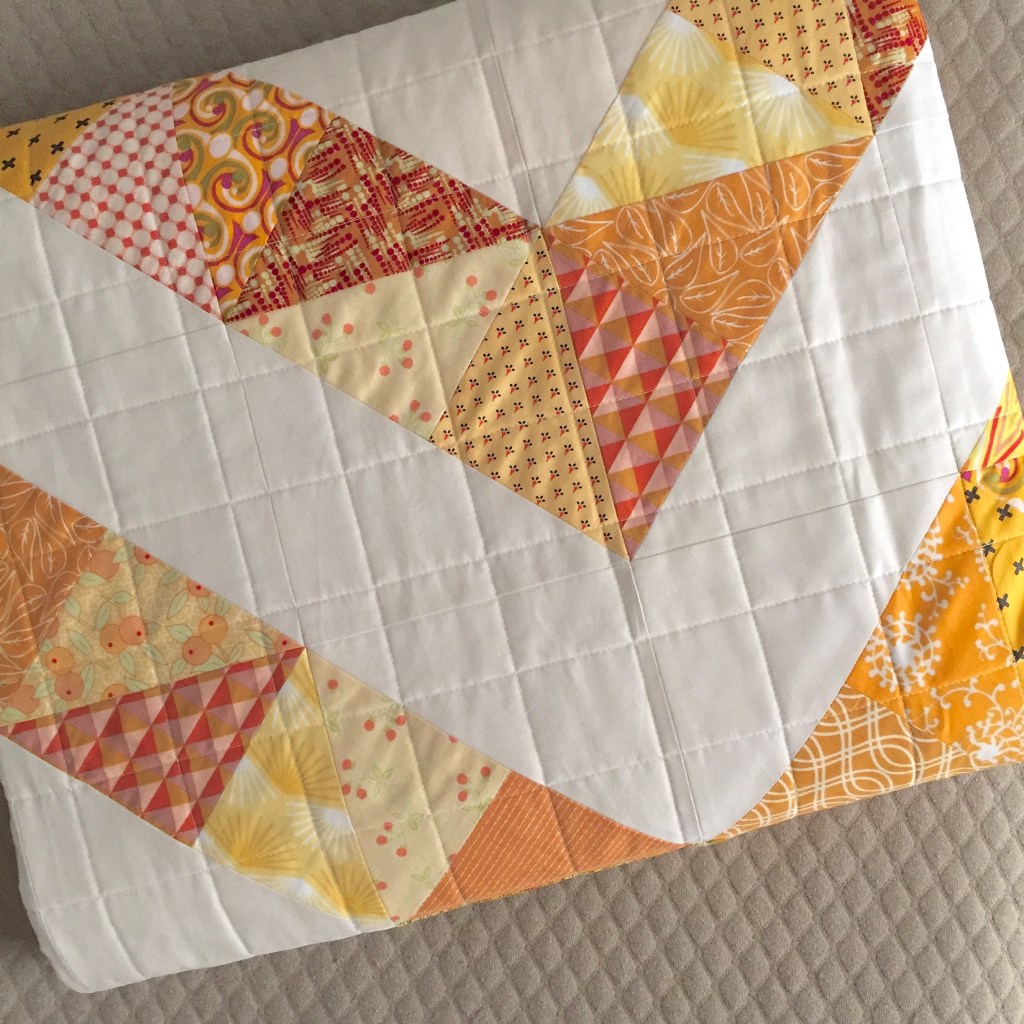
I thought quilting a grid would balance out the triangular points nicely, so I used my hera marker and quilted lines every two inches.
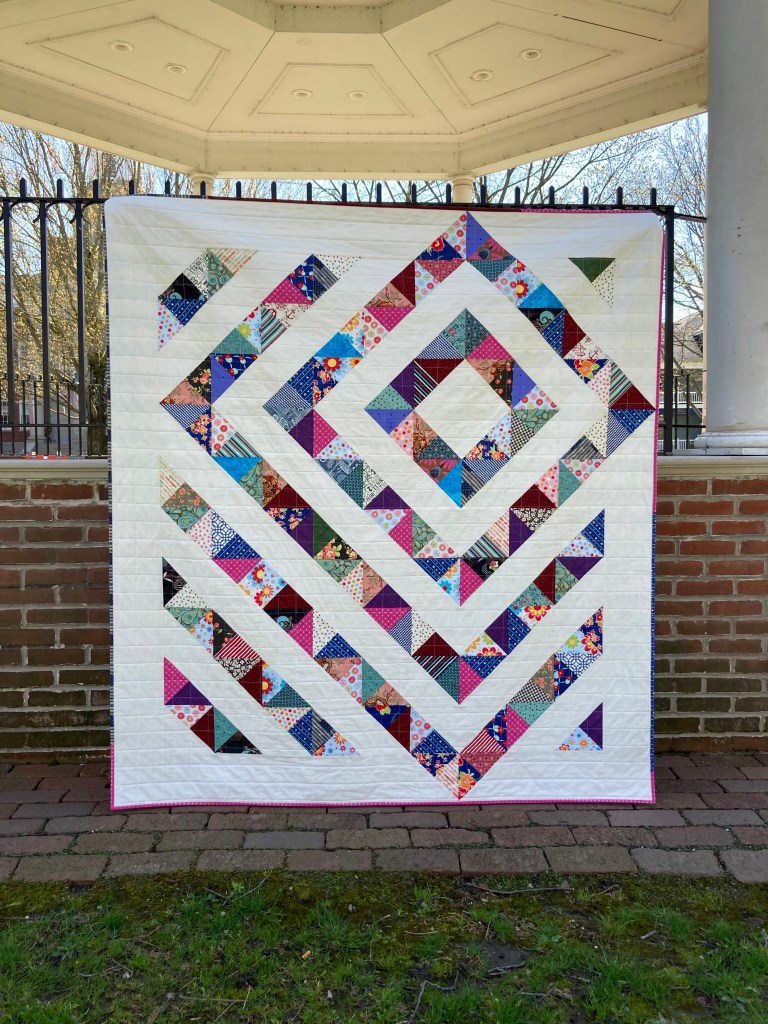
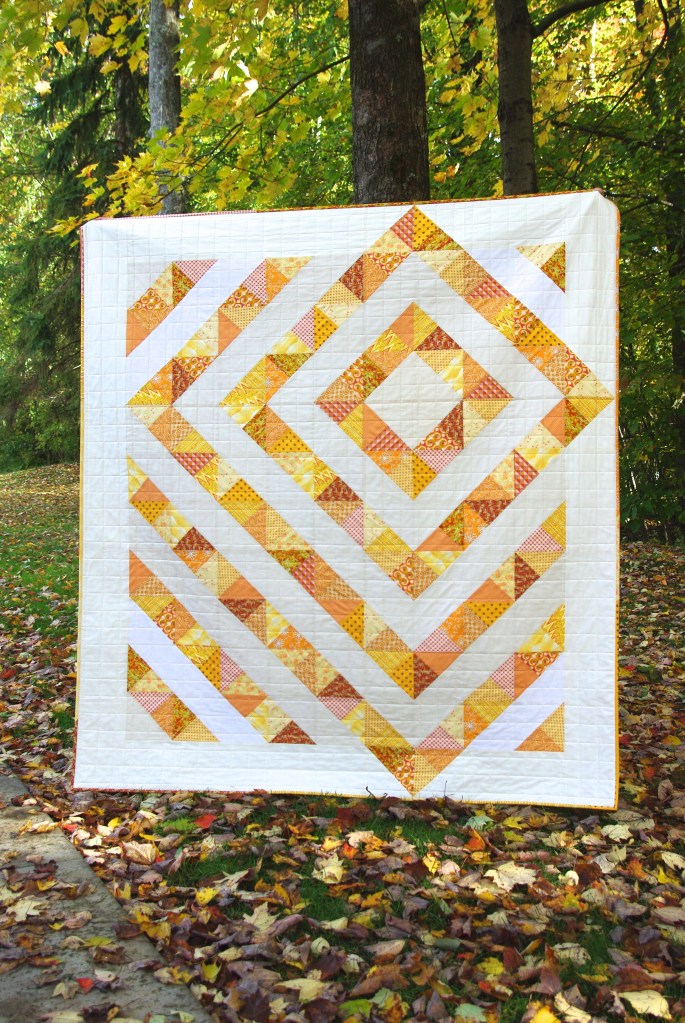
And there you have it, a finished Four Patch Charm quilt ready for a new home!
I’d love to make this quilt in every color…couldn’t you see it? 🙂
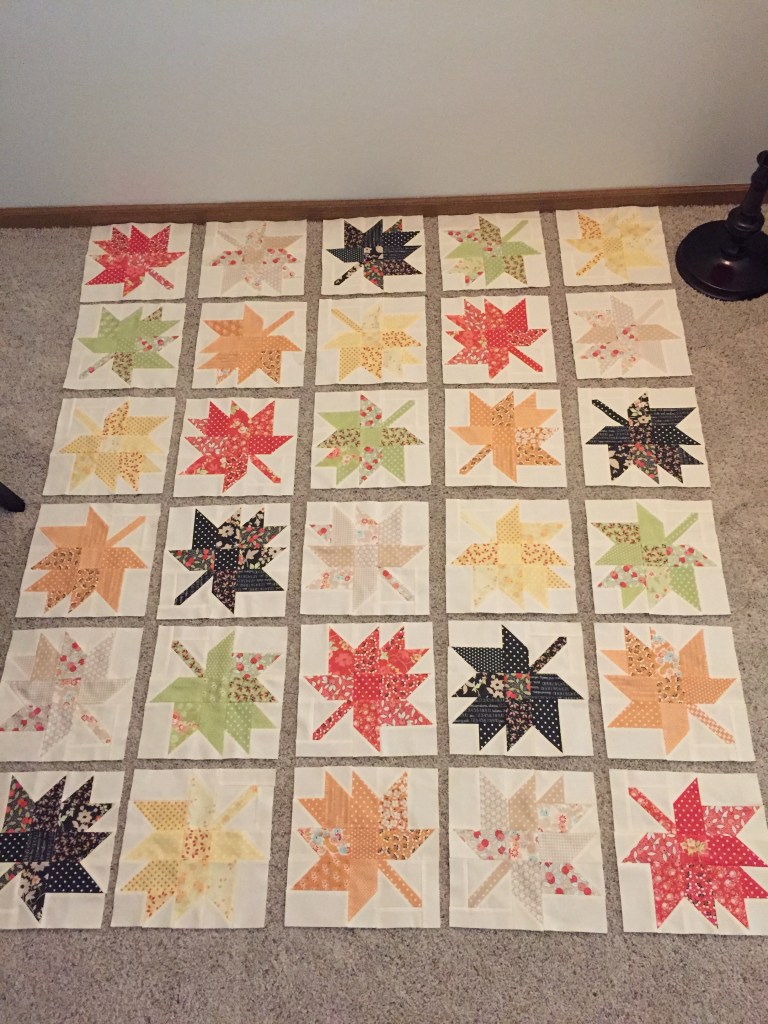
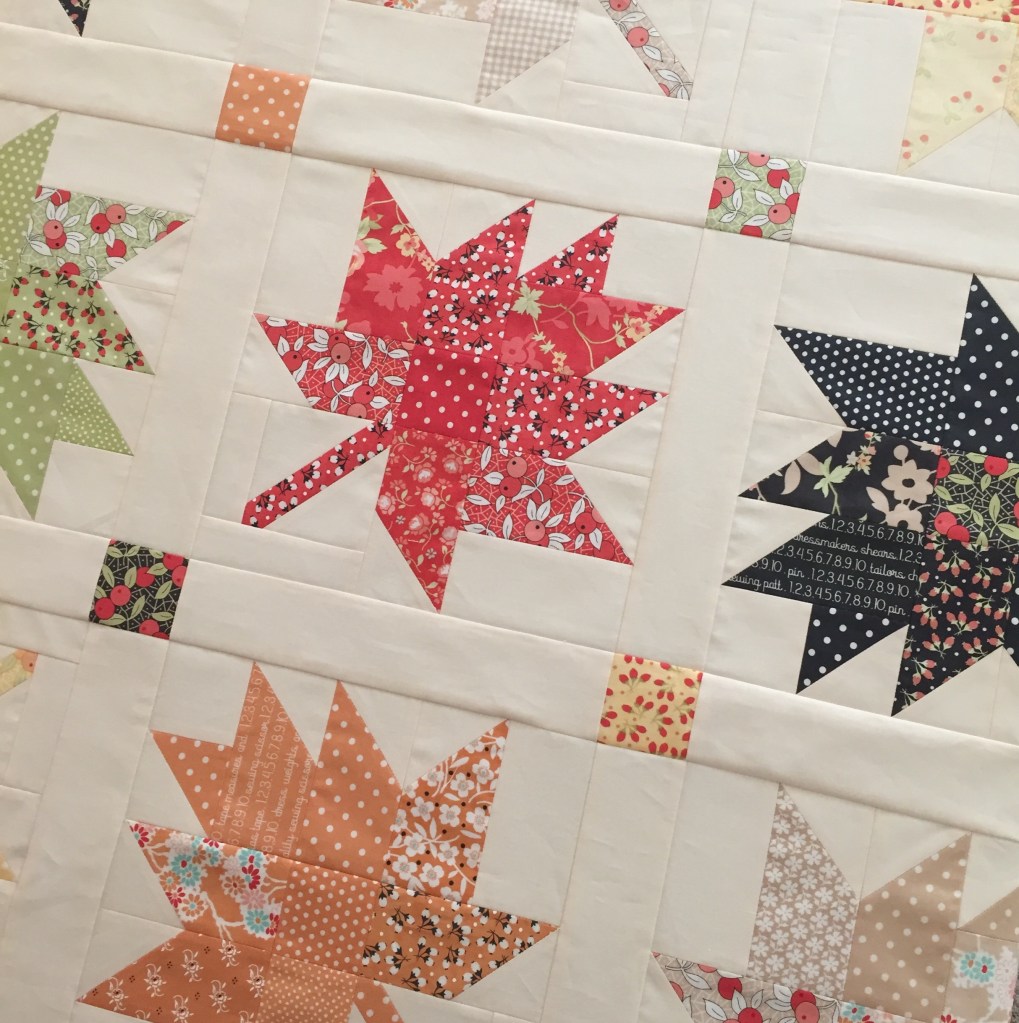
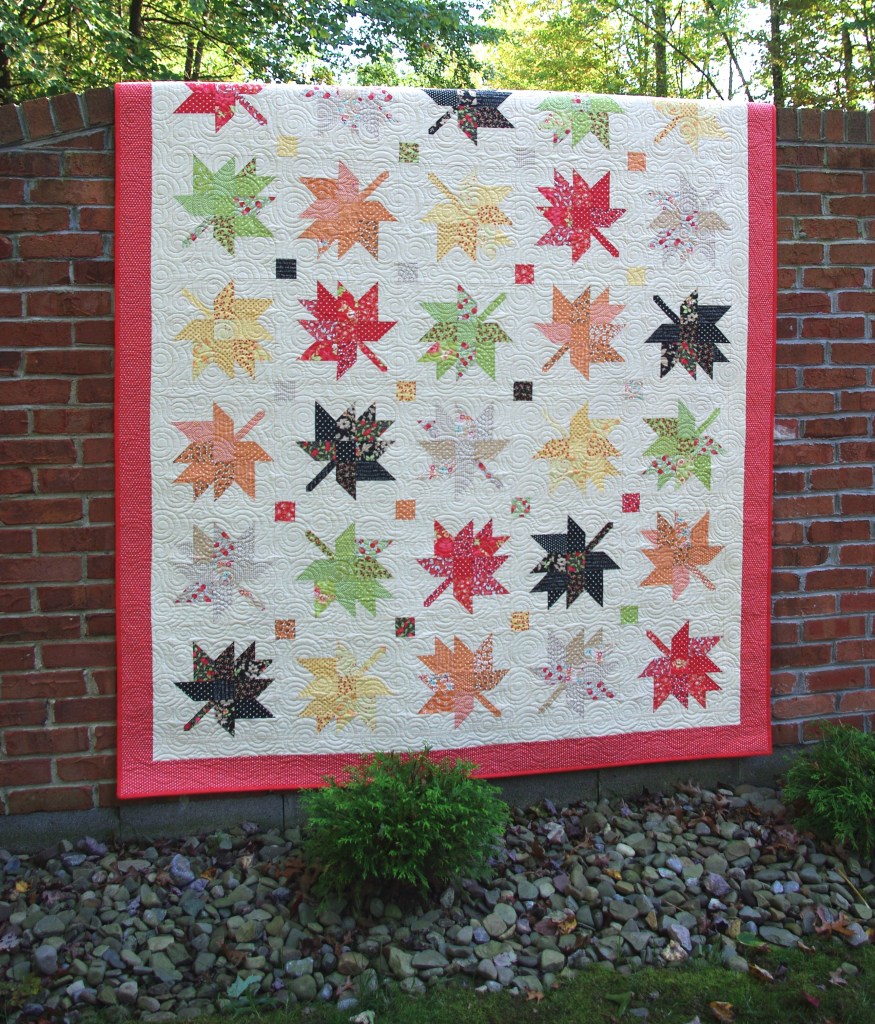
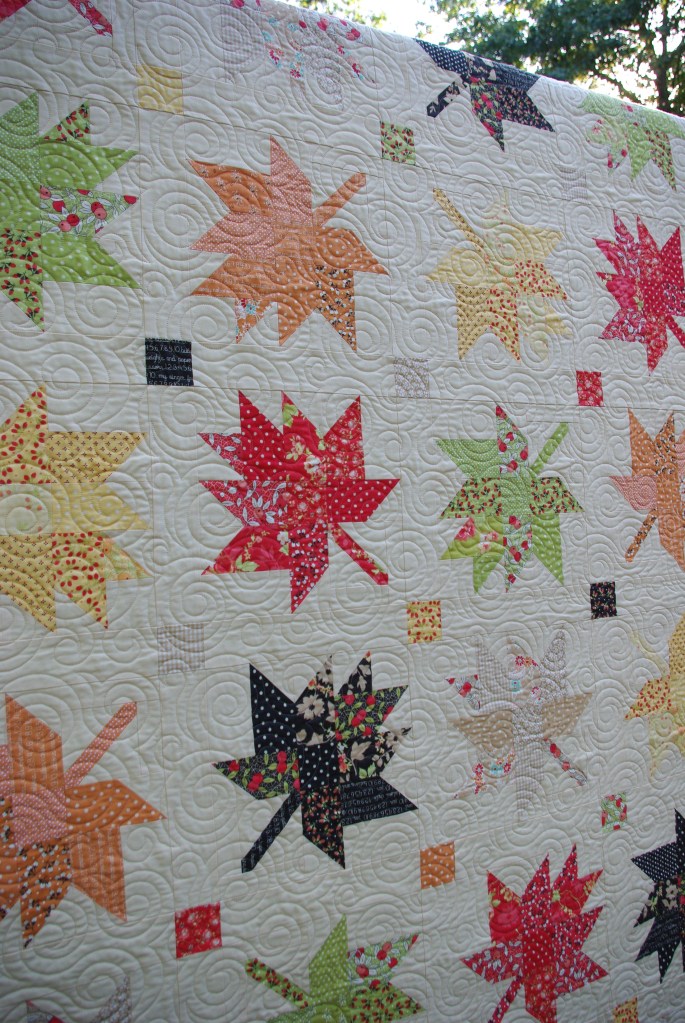
My Maple Charm quilt is finished just in time for fall, and it’s been a long time coming since I cut fabric in March 2018 and made blocks in February 2019. Shortly after that, we sold our house and moved 1,200 north where everything was nicely packed away for another time. In late summer I put the quilt top together hoping to have it done in October—mission accomplished!
Most of my quilt is made from Moda’s Chestnut Street collection by Fig Tree and Co., a bundle I purchased in October 2017!
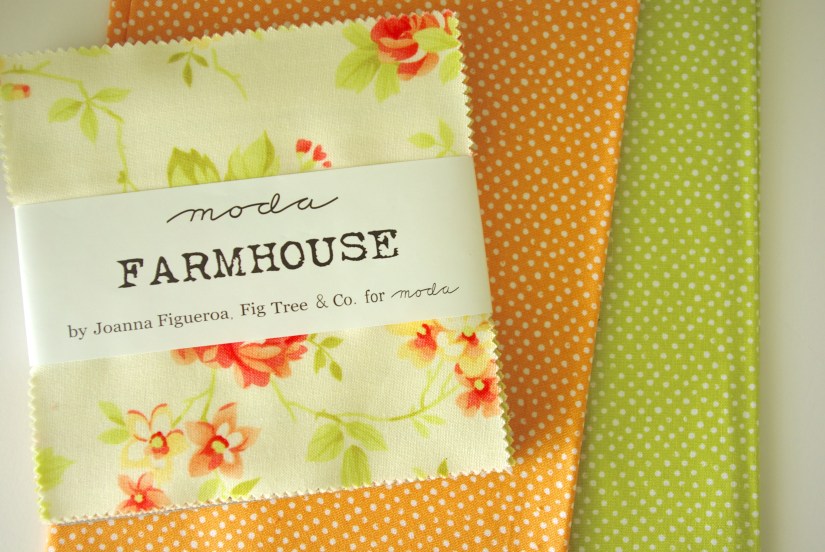
There’s also some Farmhouse fabric included as I had a charm pack from a few years ago (back when fabric stores would sell them as a daily deal for $2, remember that?!?) I only used natural leaf colors from the bundle and I added some Dear Stella Mini Dot fabric as needed.
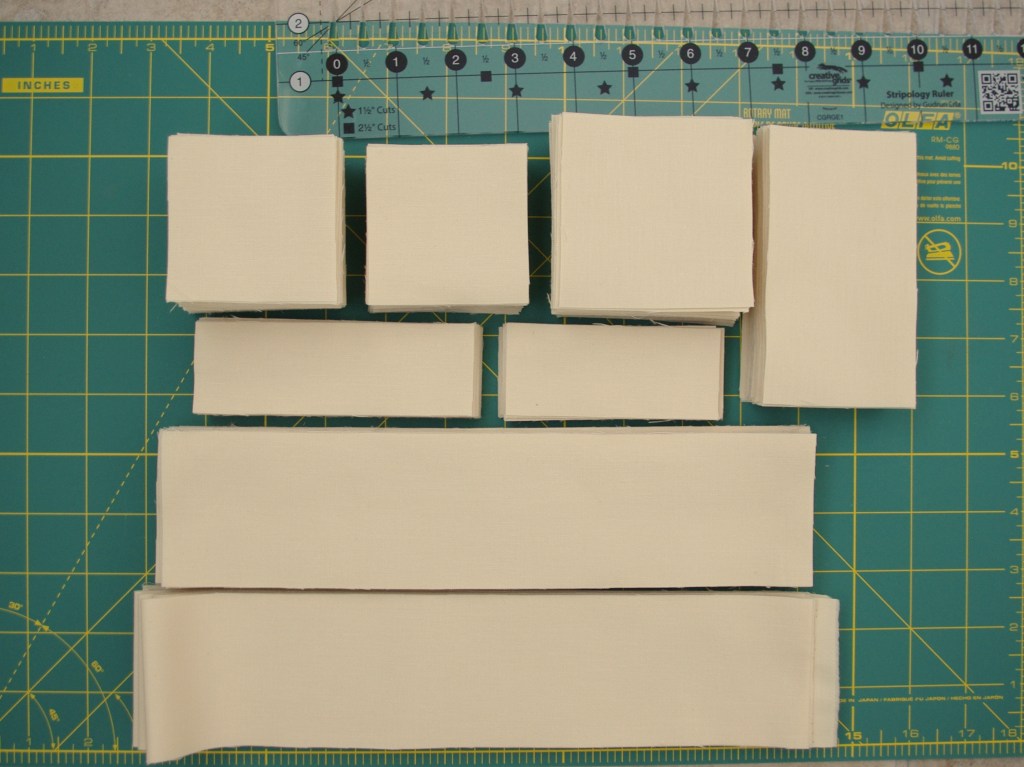
I chose Kona Cotton Cream for the background to give the quilt a nice, warm feeling. And of course I love to save on cutting time by using my Stripology ruler.
Since selling my house, I no longer have a design wall so I have to use the floor for laying out my quilt tops. 😦
Because I had all the blocks made and the sashing strips cut before moving, sewing together the quilt top went pretty fast.
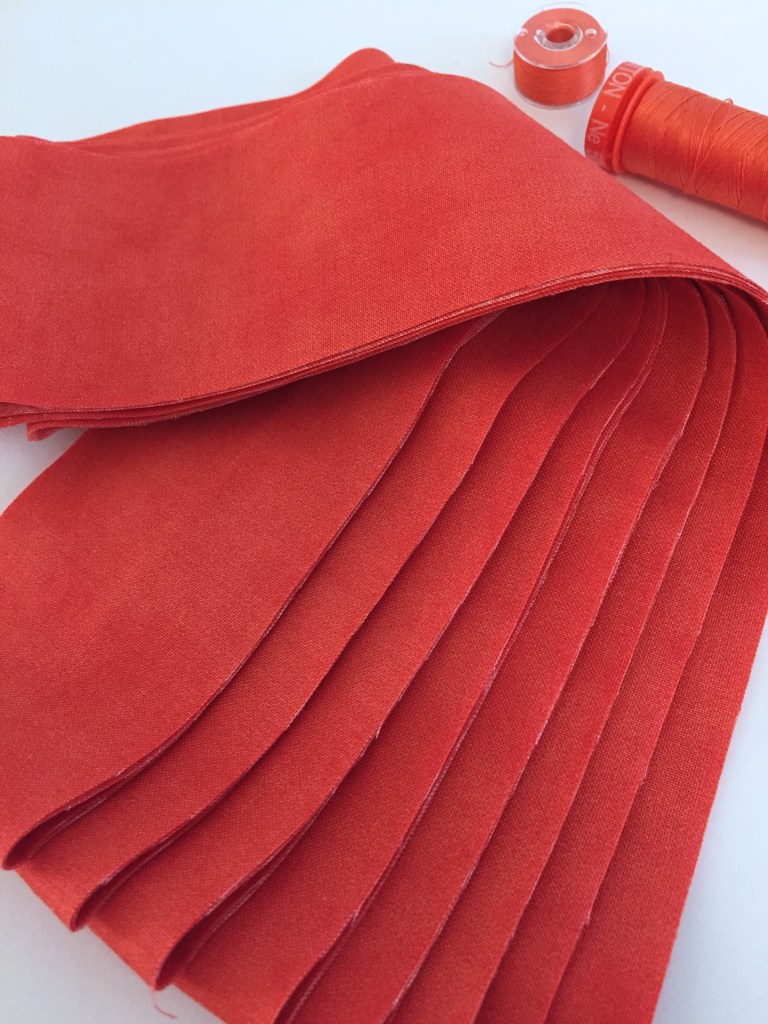
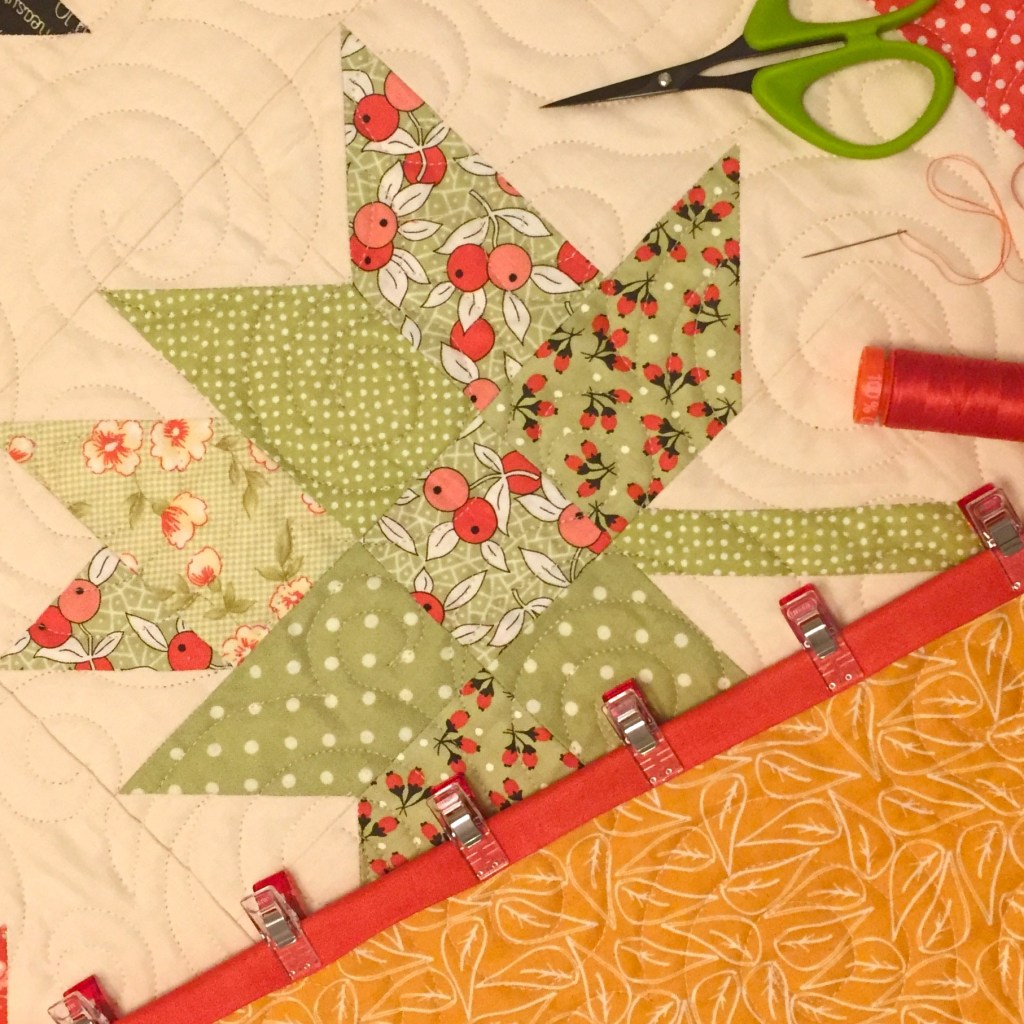
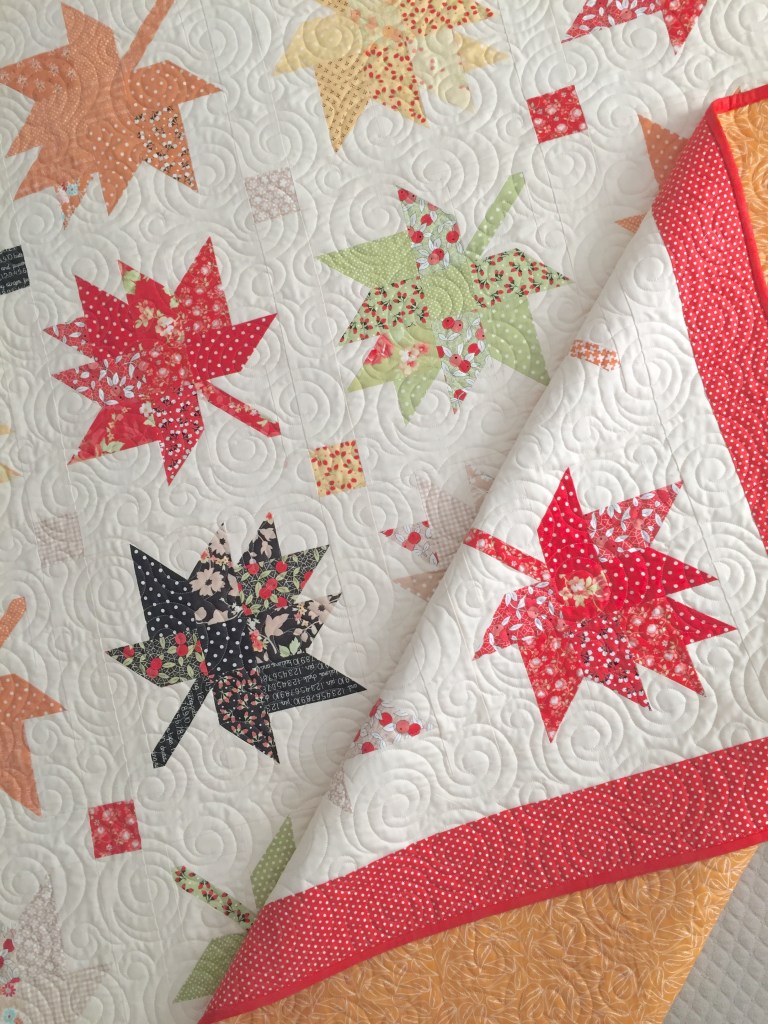
But, it wasn’t without issues…when I set out to make this quilt I didn’t plan on a border. I don’t really like borders on quilts; I just don’t feel they’re necessary (even if they’re written in the pattern). As an exception, I thought this particular quilt would look better with one, so I decided to add it. Since I didn’t purchase border fabric in the beginning, and so much time had passed since the fabric line came out, finding something I liked and available was quite a challenge! I ended up going with a red polka dot border and a solid red binding, both from Fig Tree’s Farmhouse II collection.
For the back, I used a leaf print in mustard from Moda’s Valley collection by A Quilting Life. I bought yardage on sale ages ago when I planned to make this quilt. I think it’s a perfect fit, I just love that fabric!
And after many, many months—my finished quilt!
Pattern by Coriander Quilts – Quilted in Whirlpool
I’m really happy with this fall quilt and plan to display it on my quilt ladder through Thanksgiving. After all that time it is finally finished! 🙂
I admit, I fear the bias edge. I’m not sure why really, I never had that terrible of an experience with bias edges. I guess I’m mostly afraid that something terrible is going to happen and because of that, I go out of my way to avoid them. Well, no more.
A recent quilt pattern I’ve been working on instructs you on the usual steps when making a HST—draw a diagonal line then sew ¼” from the line. Since the blocks in this quilt are multi-colored quarter square triangles, I was having a hard time getting my points aligned, so I figured I’d have better luck if I cut on the diagonal line, then sewed. I knew I’d be dealing with bias edges but I gave it a try and guess what? Not only did I have greater accuracy, it was actually easier. I fear the bias edge no longer! (I also had to remind myself that as an experienced quilter such avoidance/fear is kind of irrational). 🙂
Fast forward to my newest project that’s made up of half quarter square triangle units. It’s called Four Patch Charm and it’s similar to an Around the World quilt. I opted for this one because of the funky border and offset center and it’s forcing me to make bias edged units.
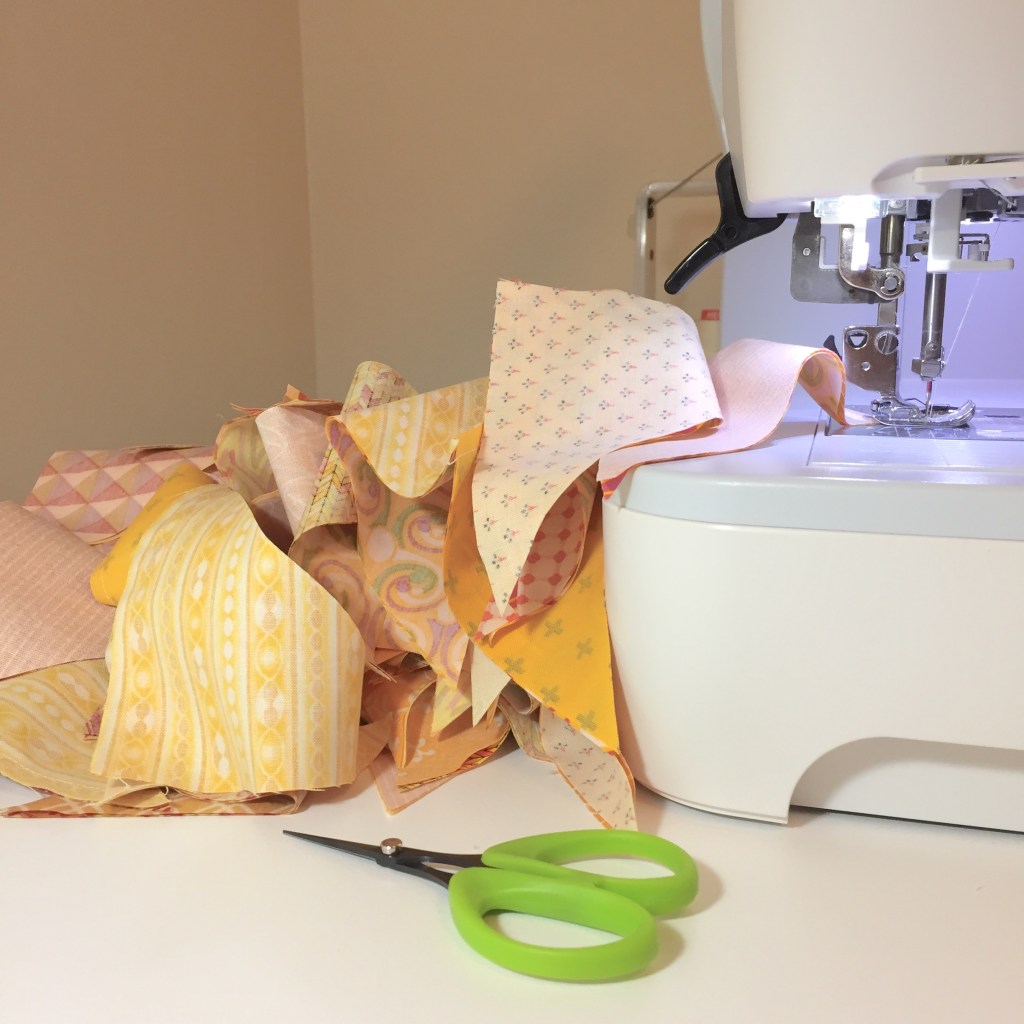
I’m continuing to make quilts with fabric I already have, and I chose a variety of golden yellows/oranges for this one. After cutting fabrics, I set to chain piecing (bias edges were present) and within 35 minutes I had 96 triangle pairs sewn.
The next step, pressing seams open…
then attaching the large half square to complete the unit. Lastly, press and trim.
No problem! Quilters know to handle bias edges gently, and to ensure that I handled them by the seams and put them on a ruler to move them from my pressing board to my sewing desk. I’m happy to say that no stretching or misshaping has occurred; I’m pretty confident everything will go together smoothly.
Now that I’ve tried a few different techniques, I won’t think twice about projects that require bias edges. If you’re like me and have avoided them, don’t! They’re not nearly as scary as you think.
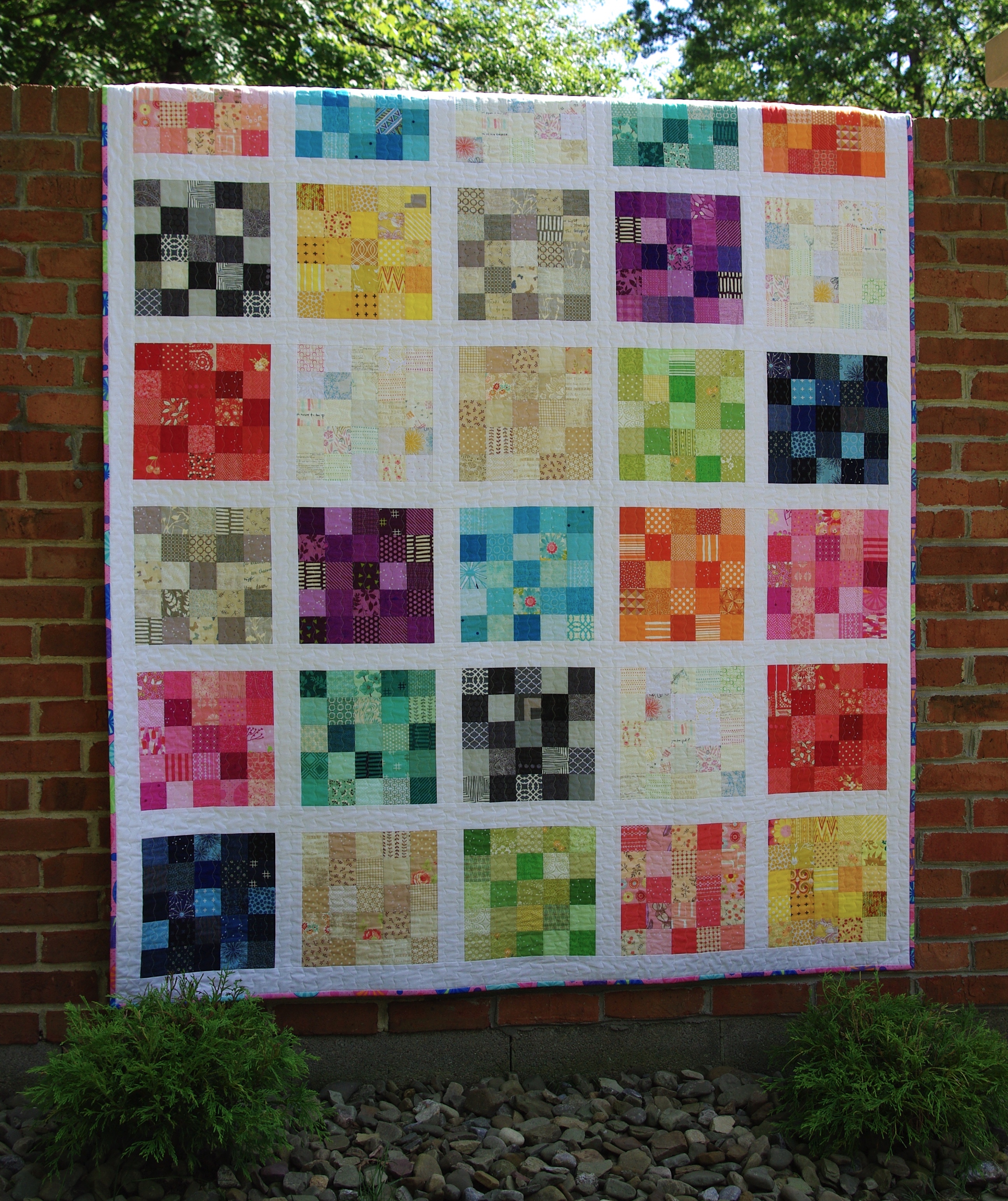
Looking for a colorful quilt that’s easy to make and designed to bust your stash? Give my Five Squared quilt a try! It’s a great way to use your scraps and it’s precut friendly. The PDF pattern is available for purchase at my Etsy shop.
Five Squared is geared for using what you’ve got on hand, and it’s an excellent choice for beginners. I realize a beginner quilter might not have that many scraps, but don’t worry, you can use 5 charm packs instead. And remember, with scrappy quilts, anything goes…
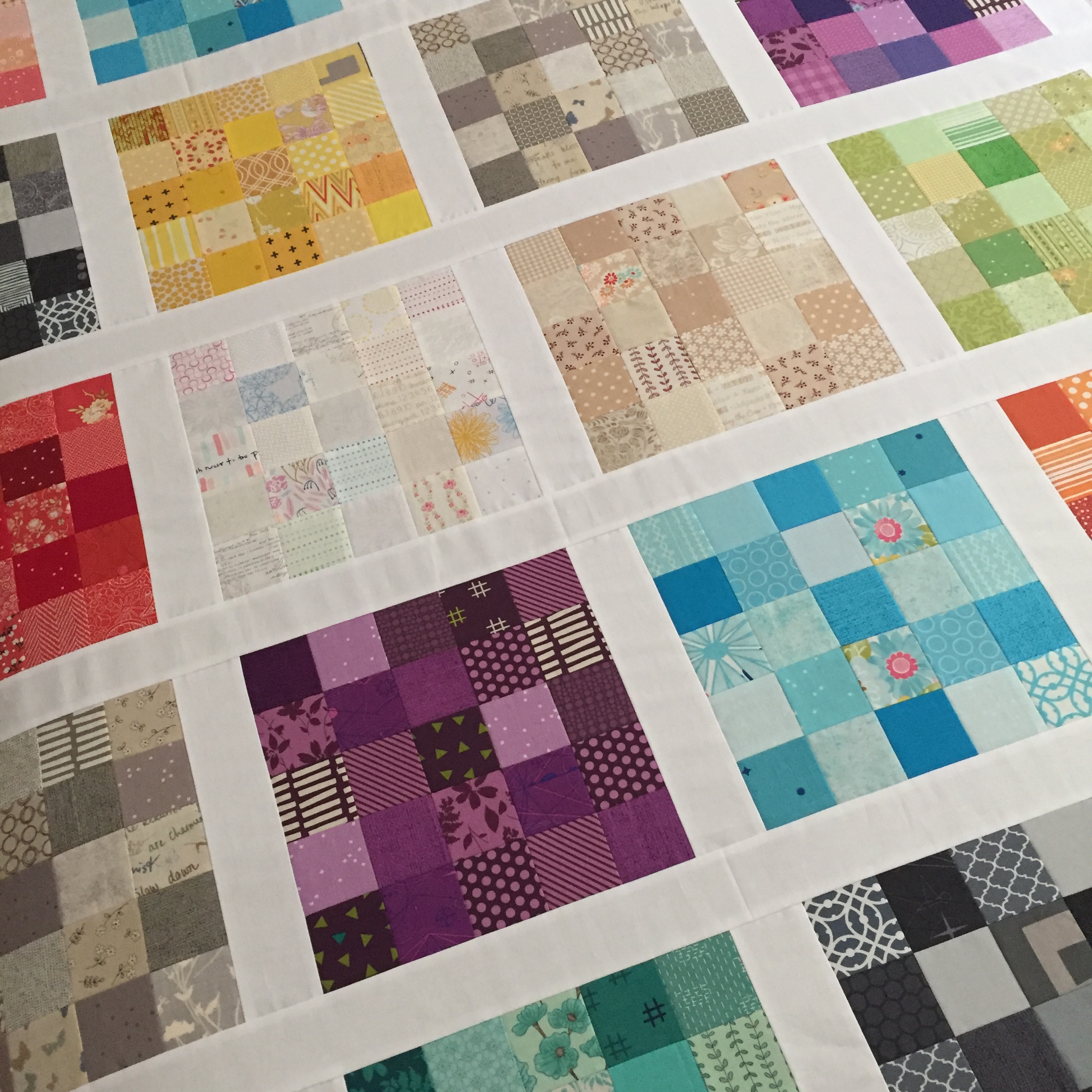
Because I like a controlled scrappy look, I decided to make mine using color-coordinated blocks with as many different colorways as my fabric would allow. I used only what I had, I bought nothing new (with the exception of the backing).
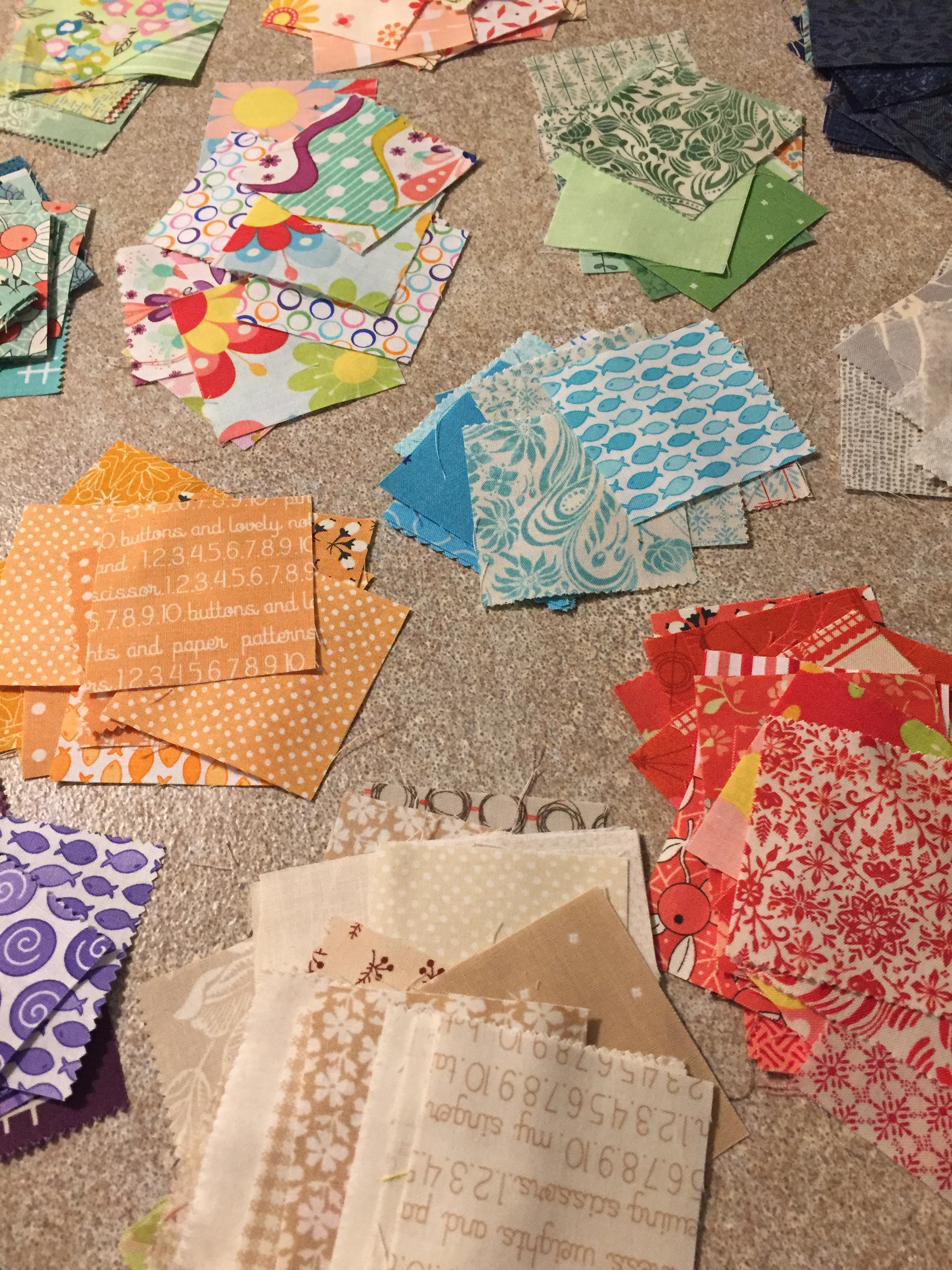
preliminary sorting of my precuts
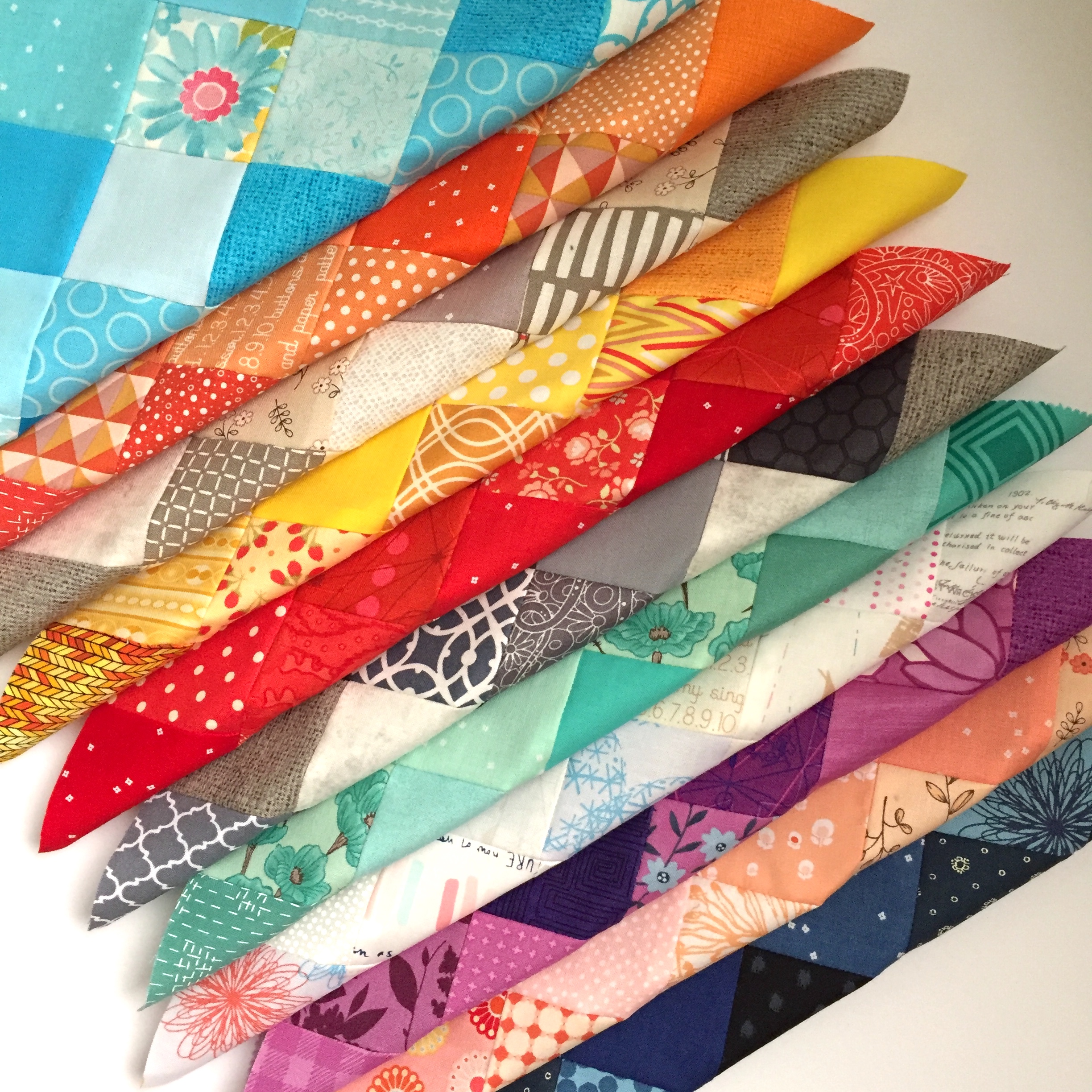
That said, I went through all my fabric and ended up with 14 different colorways: red, pink, coral, taupe, gray, aqua, teal, orange, dark blue, purple, beige, yellow, green and low volume. Ideally, 2 of 15 different colored blocks would balance out the quilt equally, but I improvised and made 4 low volume blocks instead.
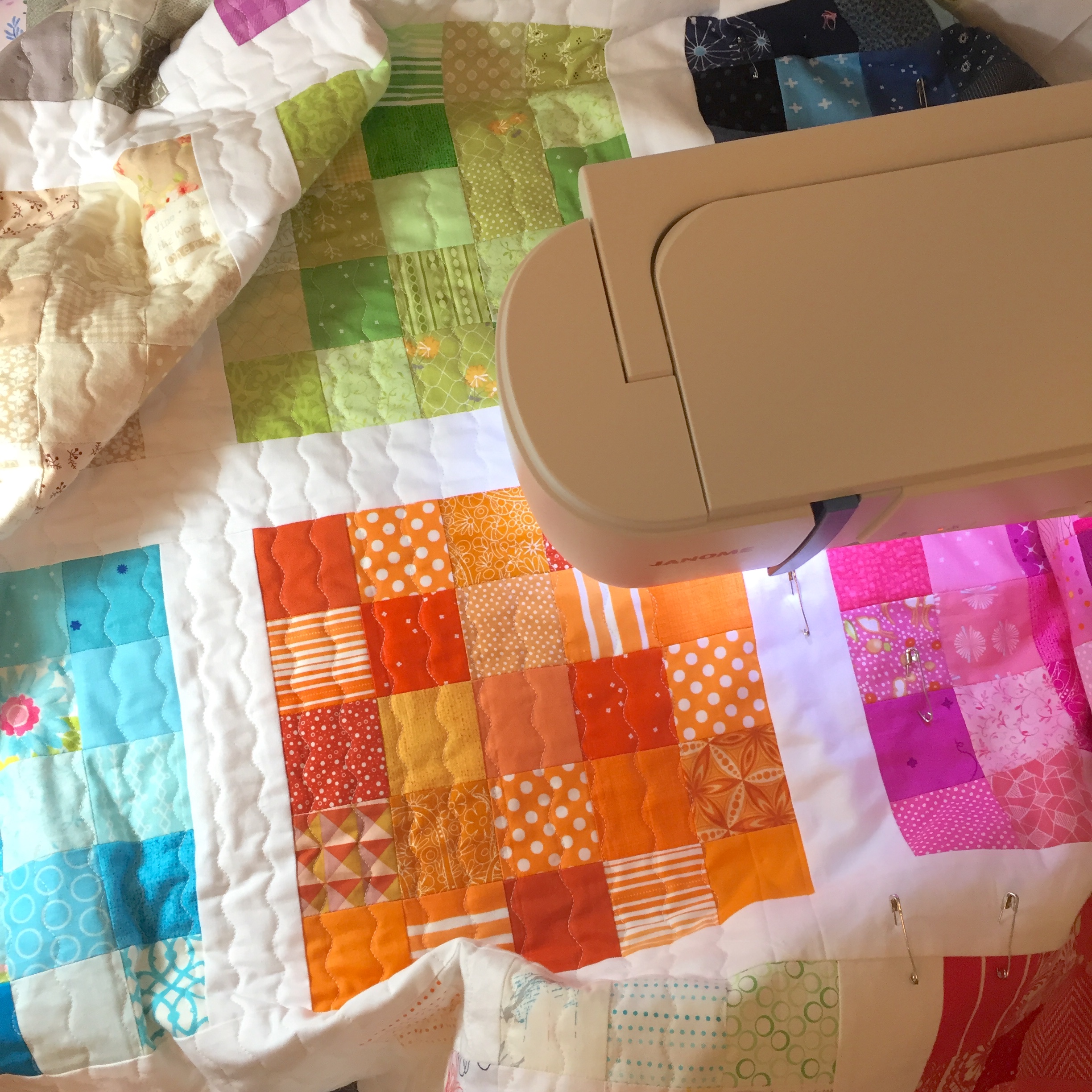
I wish I could take all my quilts to be professionally quilted but it’s not in the budget, so most of the time I do the quilting myself. While it’s not my favorite part of the quilting process, once I get going I don’t mind it all that much.
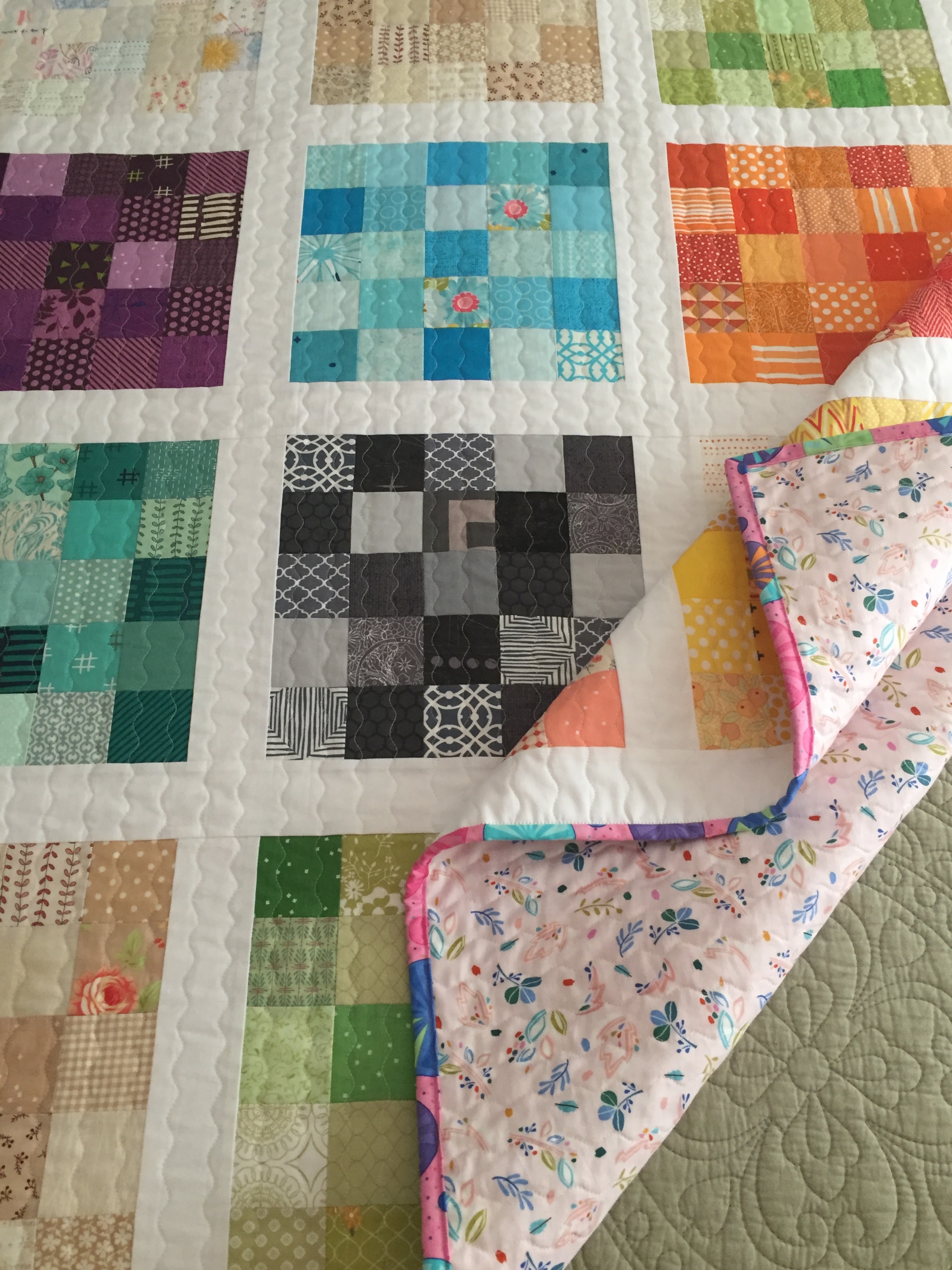
I quilted mine with serpentine stitched lines approximately 7/8″ apart, marked with a hera marker. I used Aurifil 50wt thread 2026, Chalk.
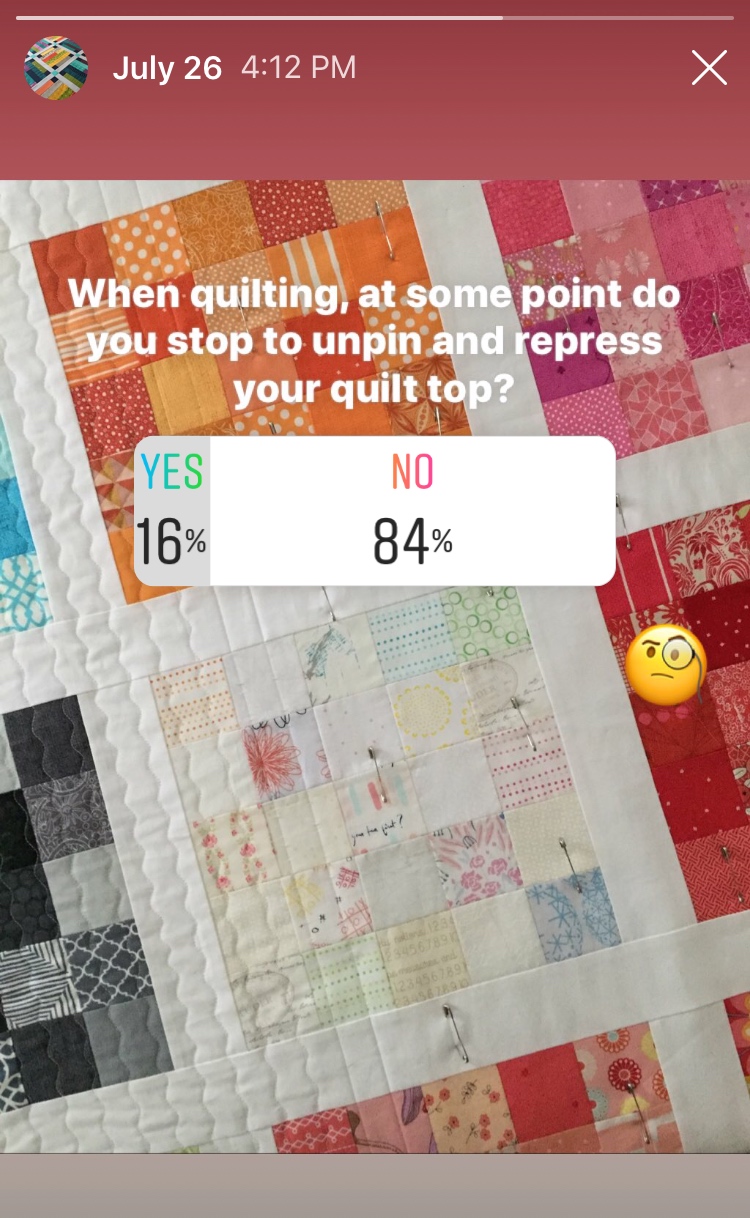
Here’s something interesting…while i was working on my quilt I did a story on Instagram asking quilters if they, at some point while quilting, unpin and repress their quilt. I was curious because I do when I’m nearing the right-hand side edge, and here’s why. At that point I’ve had the quilt rolled up pretty tight to fit through the throat of my machine, and it’s rather wrinkled. When I get to that section, I feel that taking extra time to press and repin gives me a smoother, flatter finish. Do other quilters do this I wondered? Here’s what they said…
Overwhelmingly no! I was surprised not many people did. Who knew? Guess I’m in the minority on that one.
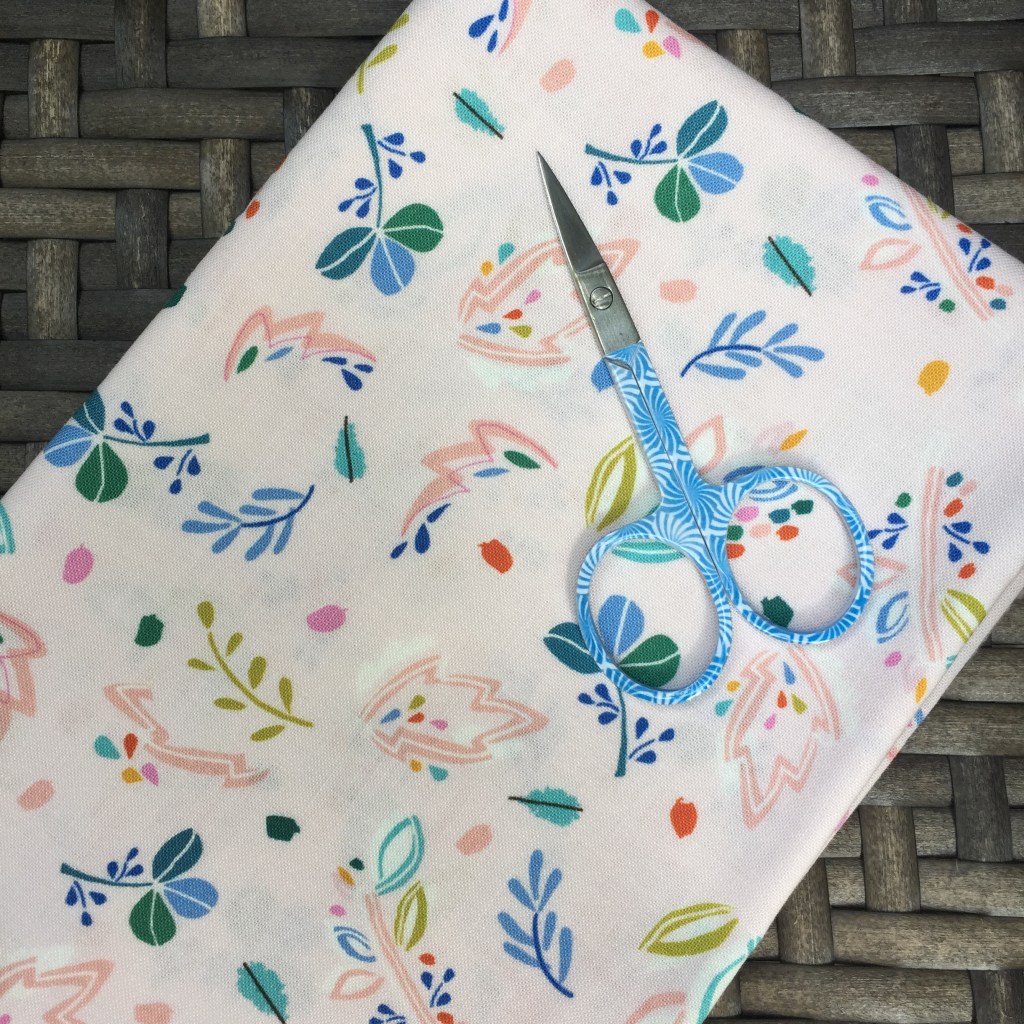
Anyway…for the backing I purchased Dear Stella Fabrics Flockstar Blush because it had every color in it that I used on the front. I absolutely love this fabric!
And it blended lovely with Moda’s Rainy Day! Umbrella Pink that I used for the binding, which I also had on hand, left over from when my Boxed Candy Toss Quilt was featured on the Moda Bake Shop.
Here’s my finished Five Squared quilt.
Not that I’m wishing away summer by any stretch but I am looking forward to cooler weather so I can finally use this beauty!
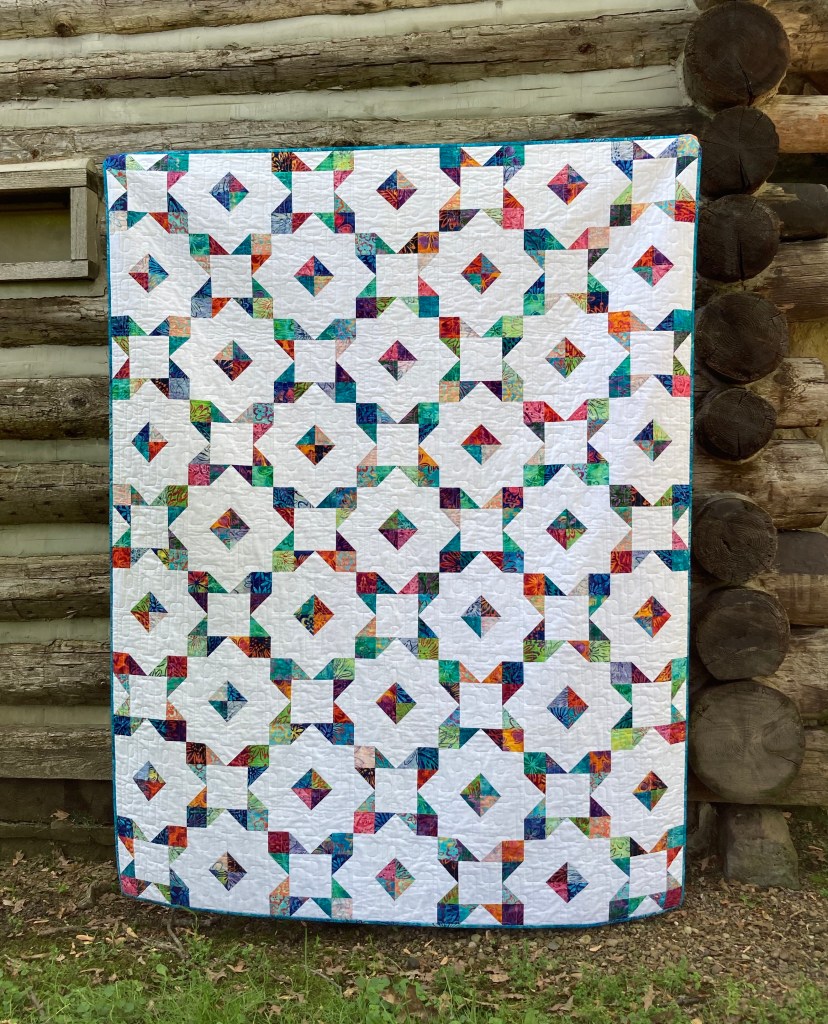
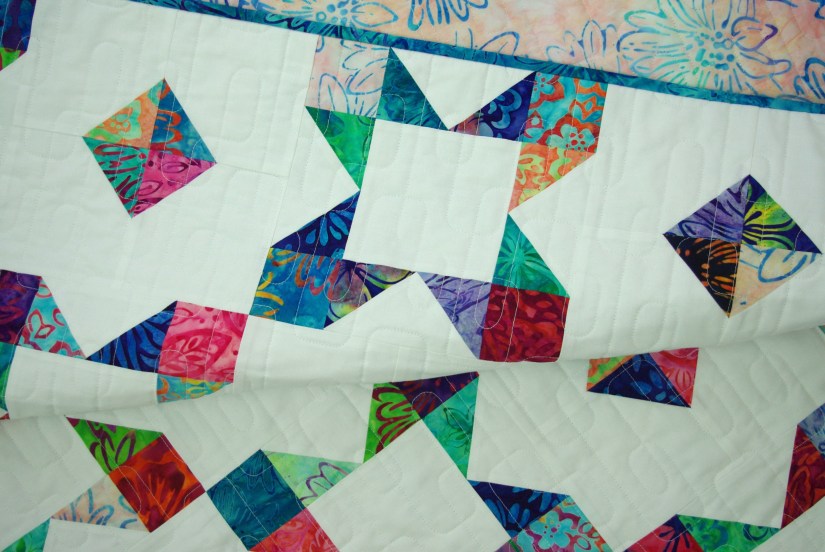
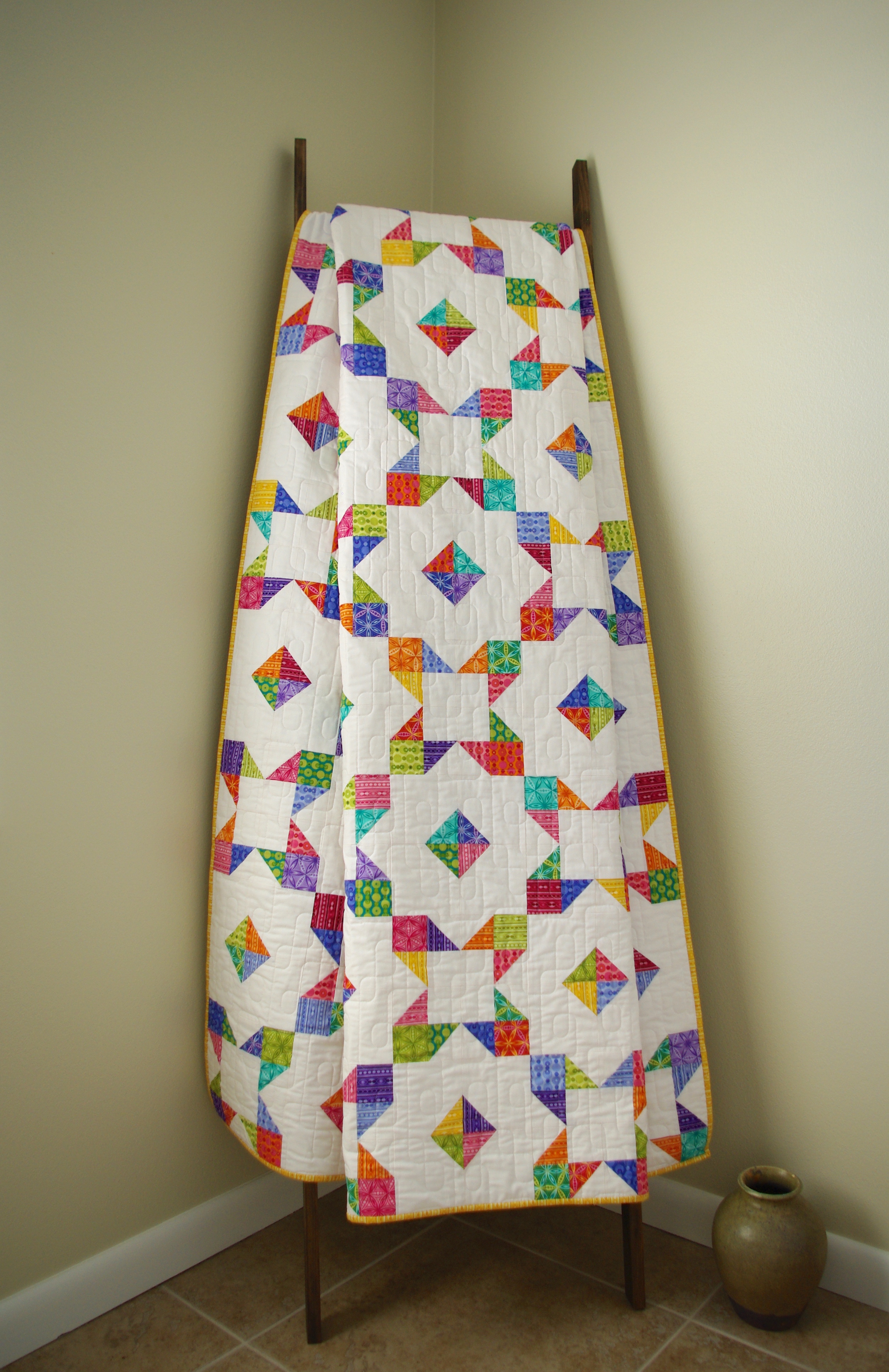
It’s Monday morning and it’s time for a pattern release! My Diamond Jubilee quilt is now available for purchase as a PDF download at my Etsy shop.
This modern quilt is throw size, measures 56″ x 72″ and it’s 2 ½” precut strip friendly. The pattern is made up of two distinct blocks, a scrappy star block and a diamond block, set in an alternate layout. And, it’s easy enough for a confident beginner quilter.
Fabric: Bright Blooms by Artisan Batiks for Robert Kaufman Fabrics Quilting: Random Curved Squares
Looking to showcase some bright fabric? Download your copy of Diamond Jubilee, have some fun sewing and celebrate an explosion of color!
If you’re on Instagram, share your project #diamondjubileequilt—I’d love to see what you create.
Every year for Christmas I make my family members something handmade. Sometimes it’s a quilt, sometimes it’s something as simple as a pillowcase. I like to start my holiday sewing early after learning my lesson two years ago when I was finishing gifts at the last minute due to a late start.
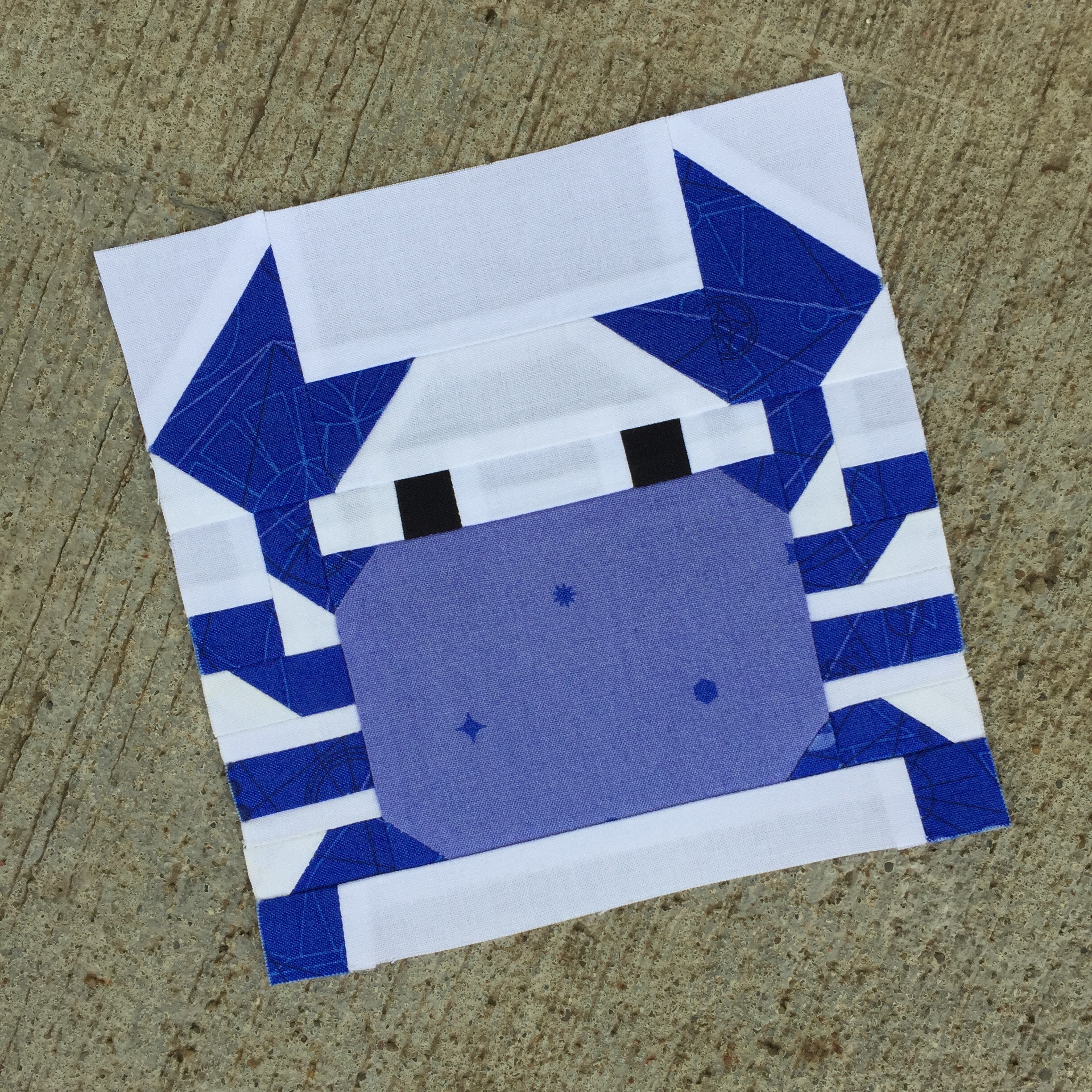
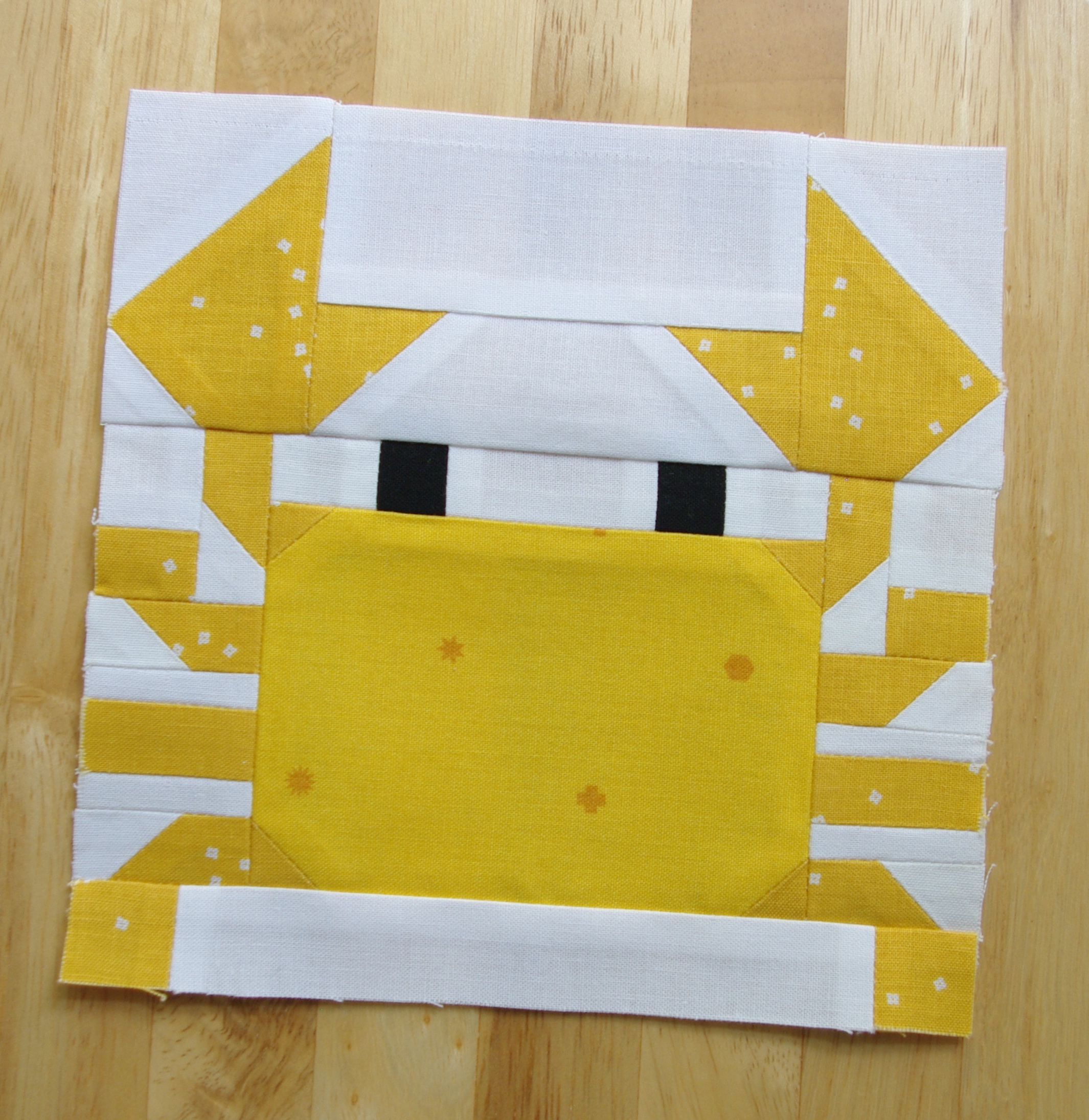
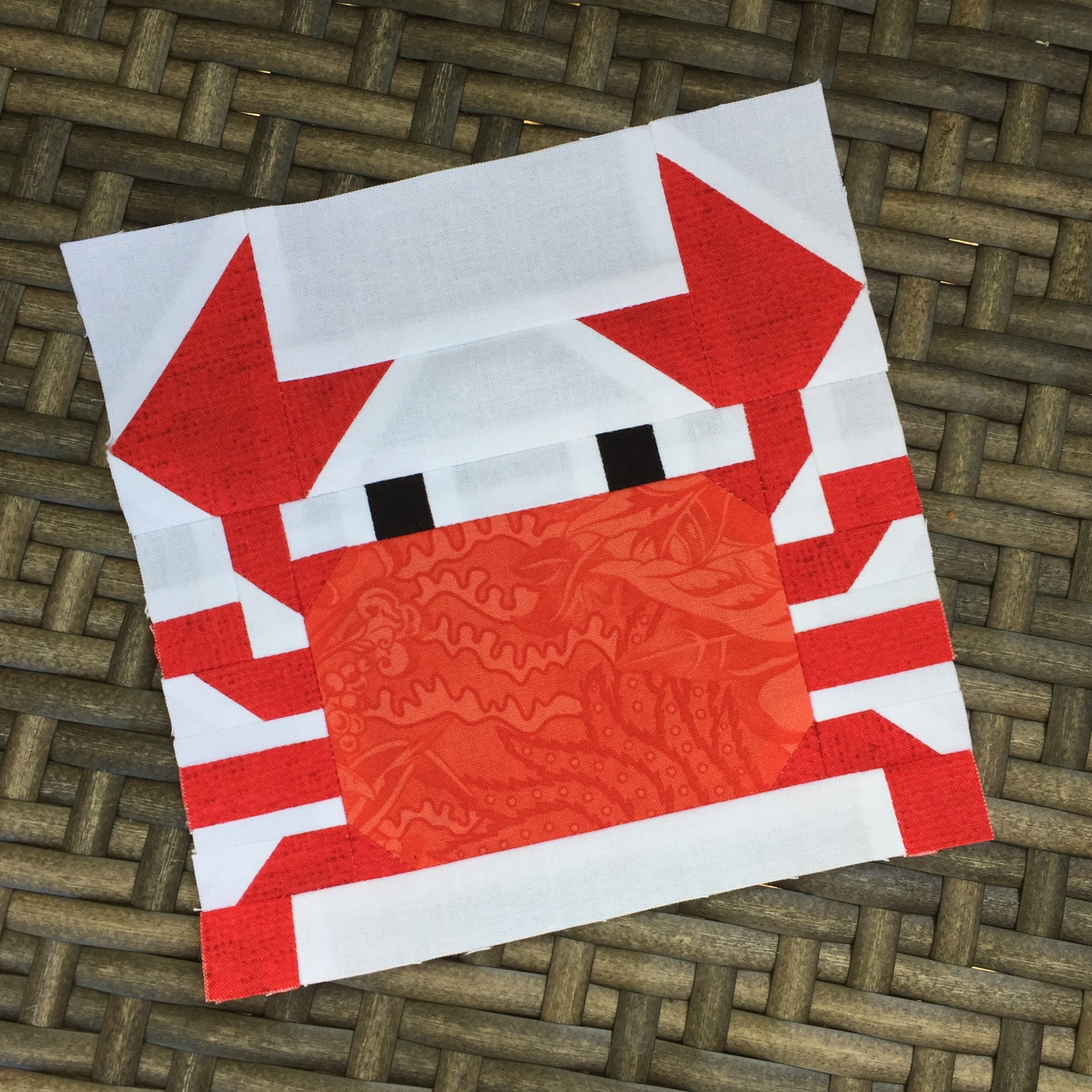
Last year I made my daughter a quilt for her bed so this year I planned to make something quite a bit smaller. Since she loves whimsical crabs, I’d been looking for a cute pattern and recently found one by EIlis and Higgs, bought it upon release and started immediately!
The pattern offers two sizes: 6″ square and 12″ square. She wanted the larger one but I thought I’d practice by making the smaller one. I decided on a blue crab and after searching through my scraps I chose two prints from Allison Glass’s Sun Print collection. To set off the vibrant blues, I used a white background.
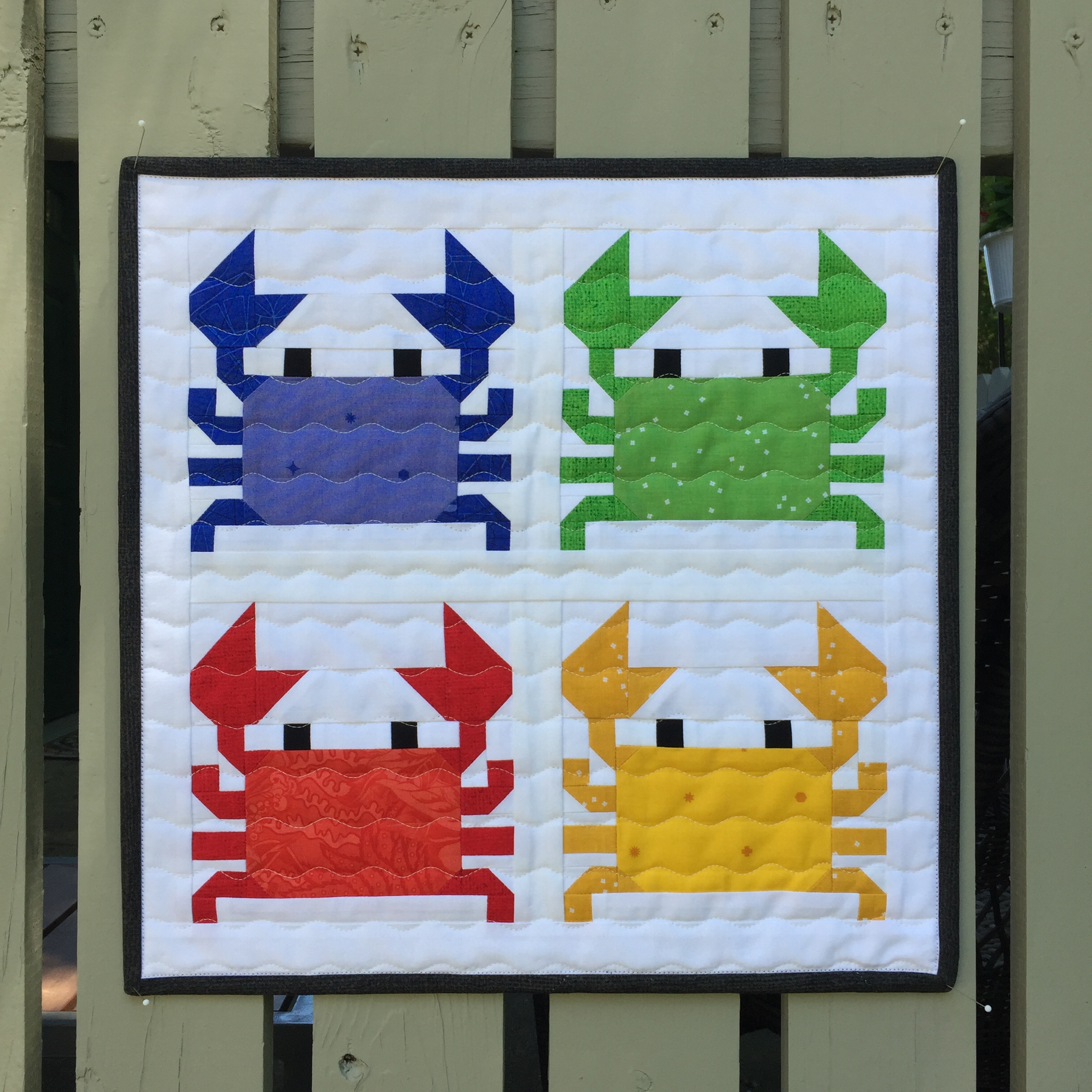
I’ve got to say—this pattern was so fun! I enjoyed it so much that I made three more crabs and created a little mini quilt for my sewing room door.
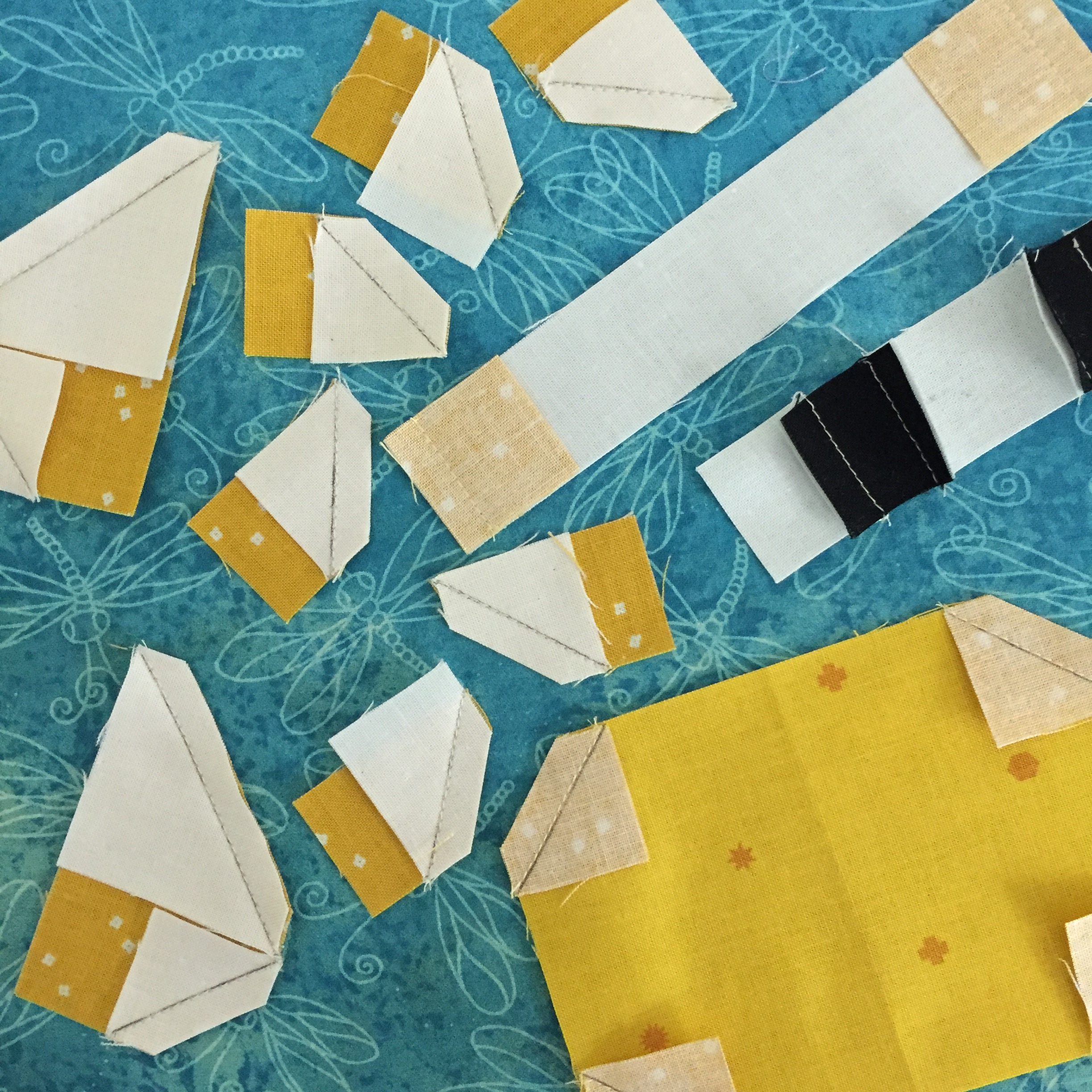
A few things to mention about the process—first of all, the fabric pieces are really small, some as small as 1″ x 1″ square and some were as skinny as ¾” wide.
Working with pieces this tiny along with striving to get everything to line up challenged me and I enjoyed the challenge! 🙂
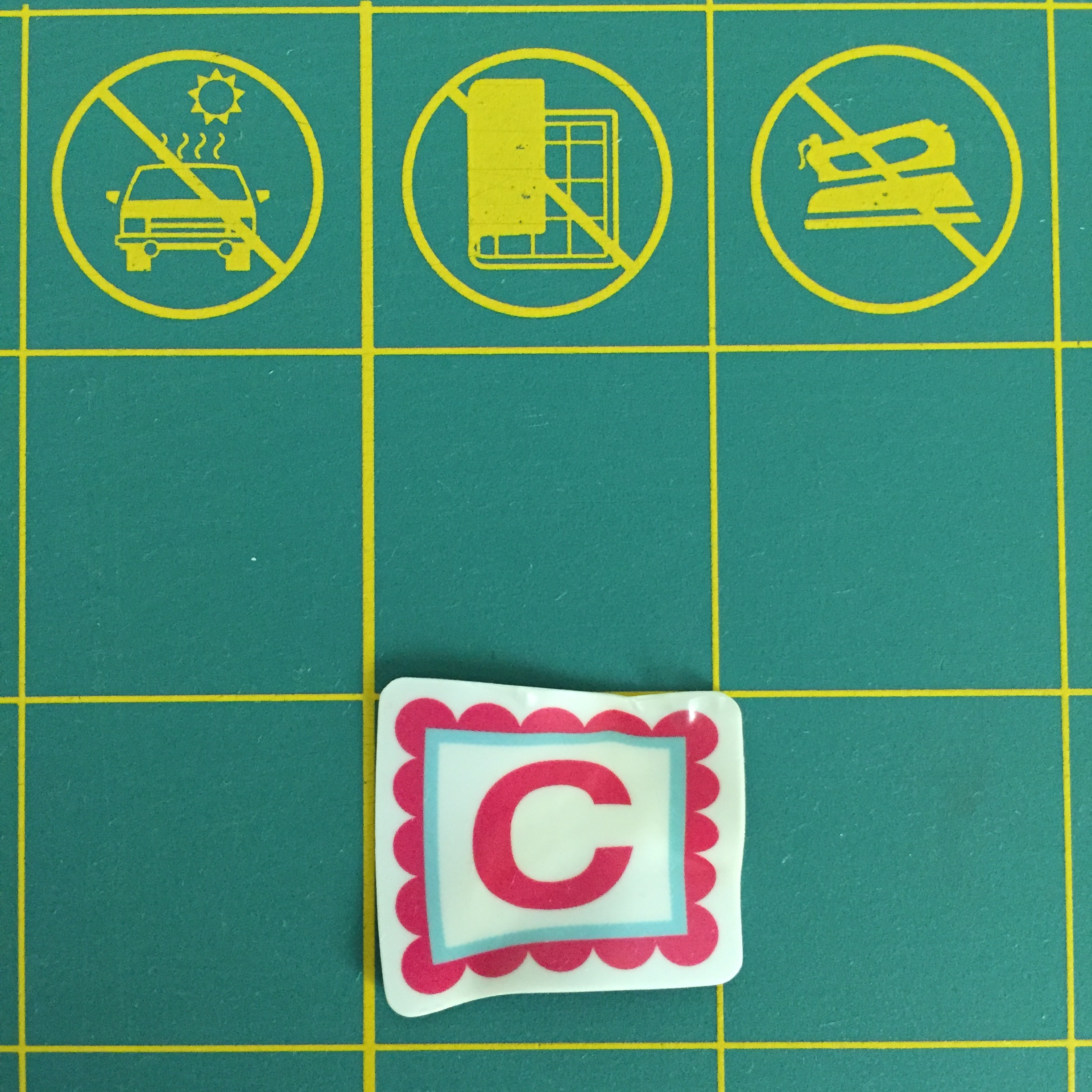
But in all that fun there were a few bumps along the way…for example, when working with such little pieces and keeping them labeled, things got a little heated…
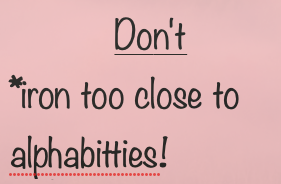
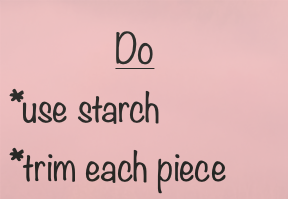
I found my alphabittie melted to my iron! Dang. After that I was a lot more careful. If you make this or any project with small pieces, I have a few recommendations:
I also found that trimming units after sewing made assemby go easier. The pattern gives sizes each sewn unit should measure and having trimmed pieces helps when lining everything up. Plus it eliminates annoying threads along the edges.
I made three tiny crabs using primary colors and green for the fourth. I added a 1 ½” border and my finished mini measures 15 ½” square. I chose a horizontal serpentine stitch for quilting to represent ocean waves. Every time I walk past my sewing room door I smile at their cuteness!
This little project was a great scrap buster, too. While going through my fabric I decided I have too much so I’m now making a controlled scrappy quilt using 2 ½” squares in every variety of color I own. And as far as the Christmas crab mini goes, I can’t post it until after it’s gifted!
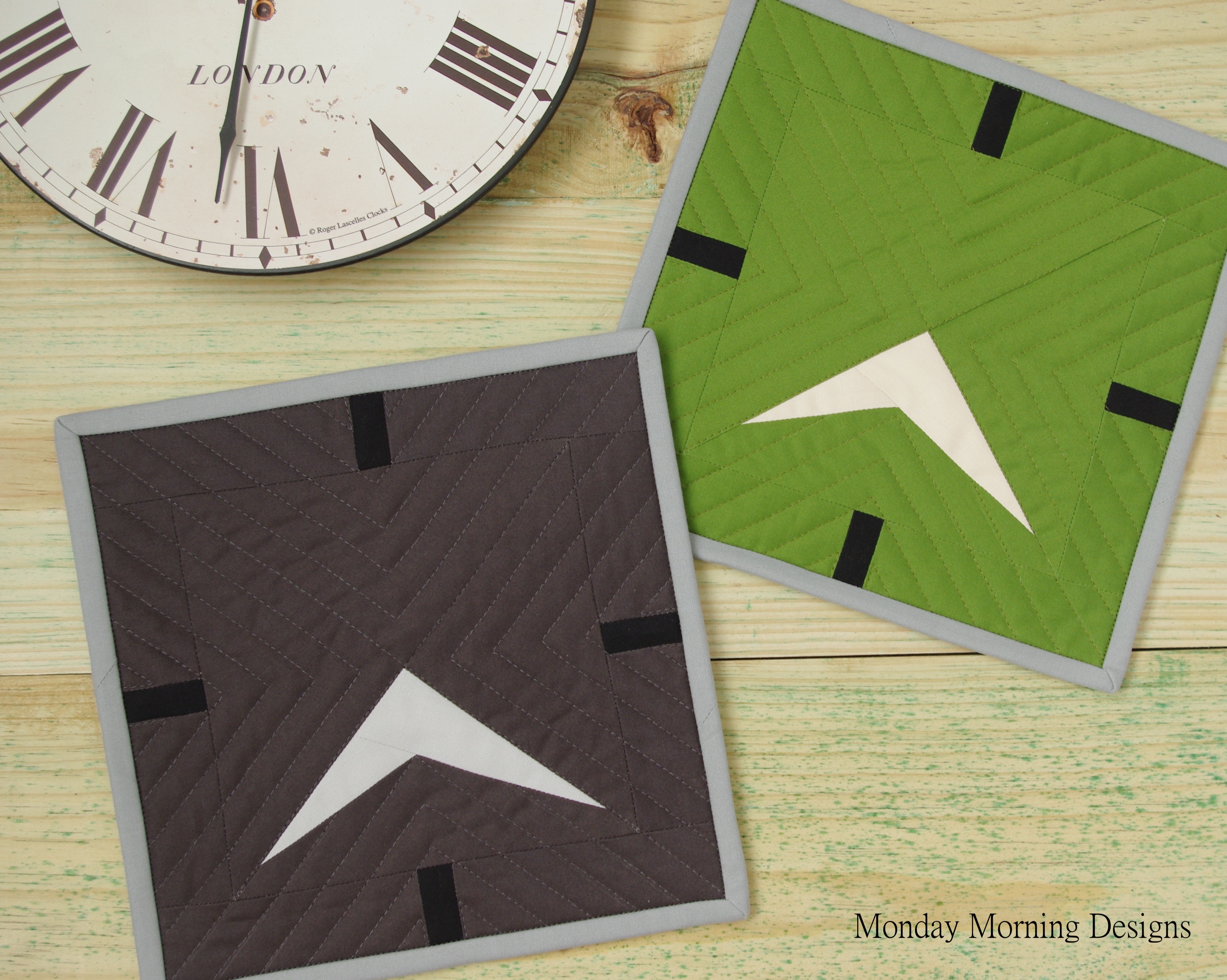
In the fall of 2017 I was fortunate enough to experience my first quilting publication. My project, Sunrise Clock Mug Rugs, was published in the September/October issue of Modern Patchwork. I designed a set of four mug rugs depicting a clock face reading approximately 7:25 a.m. For some reason I really clocks and watches, and years ago I had quite the watch collection so that’s more than likely where my inspiration came from. 🙂
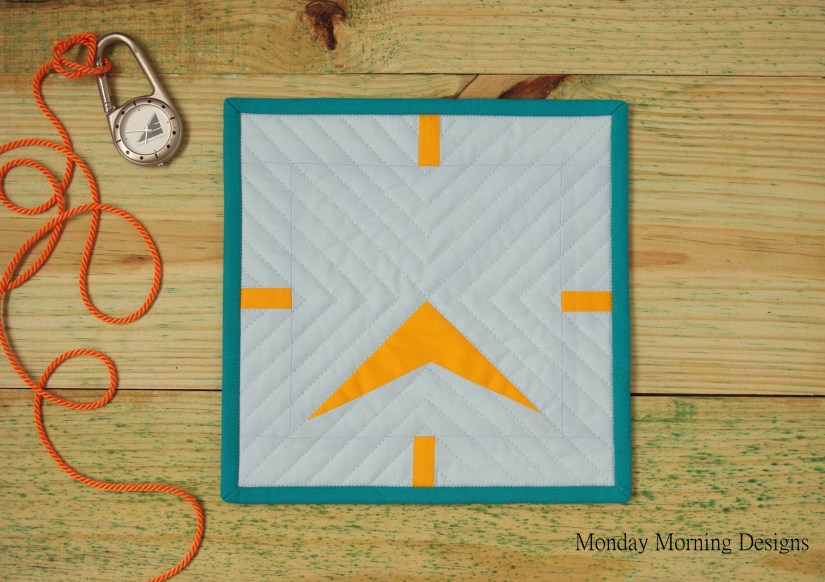
Once I had the idea, I played around with it until the design resembled a clock face as close as possible, even down to the binding which represents a silver casing! Technically, the mug rug can read four different times, depending on how you orient it. 🙂 Unfortunately, Modern Patchwork is no longer published (I was sad to see it go) so I’ve decided to offer my Sunrise Clock Mug Rug pattern as a free PDF download.
I made the original four (in the above photo) with brightly colored hands and a white background but the next time around I experimented quite a bit with color. Since I liked how the quilting design looked, I kept it the same on the others as well.
These mug rugs are a quick and fun project that presents a clean, modern aesthetic. They make great gifts, too. I’d love to see other versions, if on Instagram hashtag #sunriseclockmugrug to share yours!









 Monday Morning Designs